> ## Documentation Index
> Fetch the complete documentation index at: https://docs.flexprice.io/llms.txt
> Use this file to discover all available pages before exploring further.
# Ingesting AI Usage
> A technical look at how Flexprice normalises usage from any AI gateway or provider into a single standardised event, attaches cost, and auto-provisions metering — across real-time push, managed pull, and aggregate sources.
This page extends the [architecture overview](/docs/ai-cost-tracking/overview#architecture) with the mechanics of ingestion: the standardised event every source maps to, the connector types, how cost is attached, and how metering is provisioned for you.
The design goal is **zero manual setup**. You connect a source; Flexprice handles normalisation, pricing, and the creation of meters and features — you do not hand-write transforms, build a model price list, or define meters per model.
## The standardised AI usage event
Every source — a LiteLLM webhook, a Langfuse trace, a Bedrock log, a Databricks usage row — is normalised to one canonical shape before anything else happens. It rides on Flexprice's standard [event](/docs/event-ingestion/overview) (`event_name`, `external_customer_id`, `properties`, `timestamp`, `source`), with a fixed convention for AI properties.
```json theme={null}
{
"event_name": "ai.usage",
"external_customer_id": "team_platform",
"timestamp": "2026-06-14T10:30:00Z",
"source": "litellm",
"properties": {
"provider": "anthropic",
"model": "claude-opus-4-8",
"operation": "chat",
"input_tokens": "1840",
"output_tokens": "320",
"cached_tokens": "1024",
"reasoning_tokens": "0",
"reported_cost": "0.041",
"request_id": "req_abc123",
"raw_user": "u_91",
"raw_team": "team_platform",
"agent_id": "agent_support_bot",
"fidelity": "per_request"
}
}
```
Key fields:
| Field | Purpose |
| -------------------------------------------------------------------- | ------------------------------------------------------------------------------------------------------------- |
| `provider`, `model`, `operation` | Drive model pricing and let analytics break down by provider/model/token type. |
| `input_tokens`, `output_tokens`, `cached_tokens`, `reasoning_tokens` | Token-level usage; `unit`/`quantity` are used for non-token sources (characters, seconds, requests, credits). |
| `reported_cost` | The source's own computed cost in USD, when it provides one (most gateways do). |
| `raw_user`, `raw_team`, `agent_id`, `tags` | Source identifiers used to resolve the billing entity and hierarchy. |
| `fidelity` | `per_request` or `aggregate` — records the granularity a source can offer, so analytics stays honest. |
Following Flexprice's [event format](/docs/collectors/how-it-works#data-transformation), all `properties` values are sent as strings; Flexprice interprets numeric fields during aggregation.
## Connector types
Sources differ in whether they can push in real time, must be polled, or only expose aggregate totals. Flexprice covers all three with the same downstream pipeline.
| Type | How it works | Best for | Latency |
| ---------------- | -------------------------------------------------------------------------------------------------------------------------------------------- | ---------------------------------------------------------- | ---------------- |
| **Push (edge)** | The source POSTs each request to a [Flexprice Collector](/docs/collectors/overview) running in your infra, which transforms and forwards it. | Real-time sources and data that must stay in-network. | Real-time |
| **Managed pull** | Flexprice runs a scheduled job that reads the source over API, SQL, or object storage, transforms server-side, and ingests. | API/SQL/log-reachable SaaS and clouds — **no deployment**. | Seconds to hours |
| **Aggregate** | Flexprice ingests periodic exports (dashboard/email/usage views) and converts native units to cost. | Sources with no per-request API. | Daily |
### Push flow (e.g. LiteLLM)
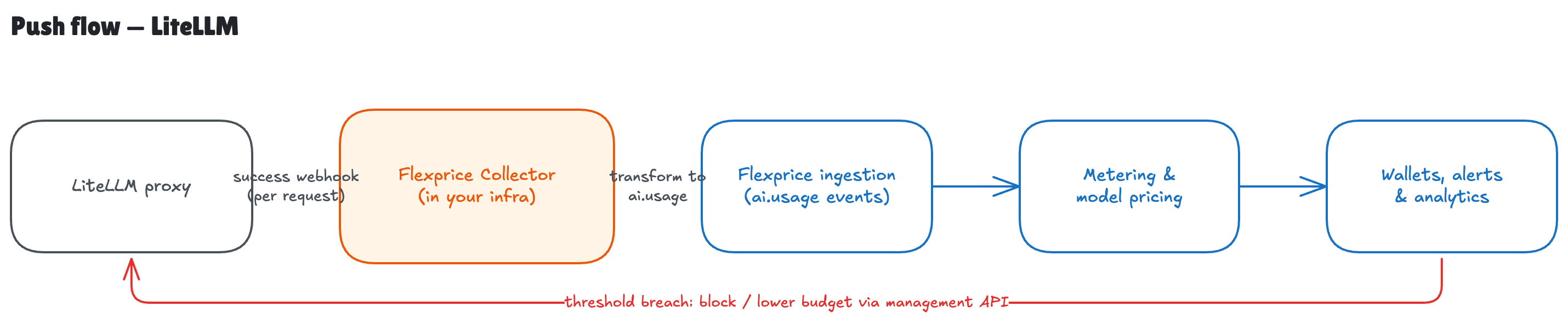 The collector is the existing [Bento-based](/docs/collectors/how-it-works) pipeline — inputs → processors → outputs — with a ready-made transform for the source, so you are not writing Bloblang by hand.
### Managed pull flow (e.g. Langfuse, Databricks, Bedrock)
The collector is the existing [Bento-based](/docs/collectors/how-it-works) pipeline — inputs → processors → outputs — with a ready-made transform for the source, so you are not writing Bloblang by hand.
### Managed pull flow (e.g. Langfuse, Databricks, Bedrock)
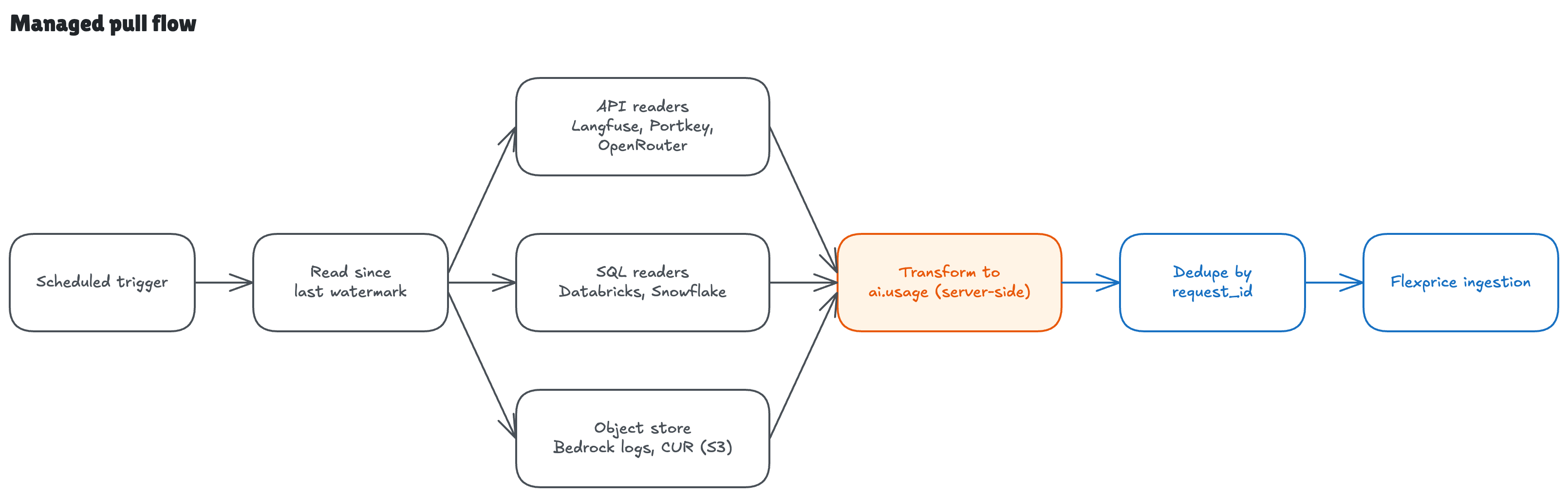 You provide read-only credentials once; Flexprice stores them securely and runs the schedule. A per-source **watermark** plus `request_id` **dedupe** guarantees no double counting across overlapping pulls.
## Integrating LiteLLM
LiteLLM is a real-time **push** source: it fires a logging callback on every completion, already carrying token counts, USD cost, model, and identity. There are three ways to wire it into Flexprice — from drop-in to fully custom — and **all three emit the same standardised `ai.usage` event**. You never define meters, features, or prices for this; enabling the LiteLLM connector with a [template](#auto-provisioning-metering) provisions them.
### Option 1 — Flexprice SDK callback (recommended)
Register the Flexprice callback and you're done — no payload mapping, no transform to maintain. Every `completion()` call you already make is metered.
```python theme={null}
import litellm
from flexprice.litellm import FlexpriceLogger
litellm.callbacks = [
FlexpriceLogger(
api_key="",
# which LiteLLM identity becomes the Flexprice billing entity
entity_from="metadata.user_api_key_team_id",
)
]
# nothing else changes — usage now flows to Flexprice on every call
litellm.completion(
model="anthropic/claude-opus-4-8",
messages=[{"role": "user", "content": "Summarise this ticket"}],
metadata={"user_api_key_team_id": "team_platform", "user_api_key_user_id": "u_91"},
)
```
The callback reads LiteLLM's per-request record, maps it to `ai.usage`, and ships it — one event per request, attributed to the team (with the user kept as a child for per-user and per-agent visibility).
### Option 2 — LiteLLM Proxy (no code)
If you run the LiteLLM **Proxy**, enable the Flexprice callback in `config.yaml`. Every request routed through the proxy — from any app, agent, or MCP server — is metered and attributed to the virtual key's team/user, with nothing to deploy in your services.
```yaml theme={null}
litellm_settings:
callbacks: ["flexprice"]
environment_variables:
FLEXPRICE_API_KEY: ""
# map a LiteLLM virtual-key dimension to the billing entity
FLEXPRICE_ENTITY_FROM: "metadata.user_api_key_team_id"
```
When usage must stay inside your network, point LiteLLM's logging webhook at your in-infra [Flexprice Collector](/docs/collectors/overview) instead — the collector applies the same transform before anything leaves your VPC.
### Option 3 — Custom callback (full control)
When you want to shape the event yourself — add tags, override the entity, or filter calls — implement a LiteLLM `CustomLogger` and send the event with the Flexprice SDK. This is exactly what Option 1 does under the hood, exposed for you to customise.
```python theme={null}
from litellm.integrations.custom_logger import CustomLogger
import litellm
from flexprice import Flexprice
fp = Flexprice(api_key="")
class FlexpriceLogger(CustomLogger):
async def async_log_success_event(self, kwargs, response_obj, start_time, end_time):
# LiteLLM's normalised, per-request usage + cost record
slp = kwargs["standard_logging_object"]
meta = slp.get("metadata", {})
fp.events.ingest(
event_name="ai.usage",
external_customer_id=meta.get("user_api_key_team_id", "unknown"),
source="litellm",
properties={
"provider": slp["custom_llm_provider"],
"model": slp["model"],
"operation": "chat",
"input_tokens": slp["prompt_tokens"],
"output_tokens": slp["completion_tokens"],
"reported_cost": slp["response_cost"], # USD, computed by LiteLLM
"request_id": slp["id"],
"raw_user": meta.get("user_api_key_user_id"),
"raw_team": meta.get("user_api_key_team_id"),
},
)
litellm.callbacks = [FlexpriceLogger()]
```
### The event Flexprice receives
Whichever option you pick, the same canonical event lands — already mapped, ready to be priced and attributed:
```json theme={null}
{
"event_name": "ai.usage",
"external_customer_id": "team_platform",
"source": "litellm",
"properties": {
"provider": "anthropic",
"model": "claude-opus-4-8",
"operation": "chat",
"input_tokens": "1840",
"output_tokens": "320",
"reported_cost": "0.041",
"request_id": "req_abc123",
"raw_user": "u_91",
"raw_team": "team_platform"
}
}
```
If you'd rather not use an SDK at all, the same event can be posted directly to the [events API](/docs/event-ingestion/sending-events):
```bash theme={null}
curl -X POST https://api.cloud.flexprice.io/v1/events \
-H 'x-api-key: ' \
-H 'Content-Type: application/json' \
-d '{
"event_name": "ai.usage",
"external_customer_id": "team_platform",
"source": "litellm",
"properties": {
"provider": "anthropic", "model": "claude-opus-4-8",
"input_tokens": "1840", "output_tokens": "320",
"reported_cost": "0.041", "request_id": "req_abc123"
}
}'
```
### Closing the loop — enforcement
Because Flexprice now holds the source of truth for spend, a budget breach can act **back** on LiteLLM (the dashed return path in the push-flow diagram). On a `warning`/`critical` [alert](/docs/customers/threshold-notifications), Flexprice calls LiteLLM's management API with your master key to throttle the offending key or team:
```bash theme={null}
# soft: zero out the remaining budget on a key
curl -X POST https:///key/update \
-H 'Authorization: Bearer ' \
-H 'Content-Type: application/json' \
-d '{ "key": "", "max_budget": 0 }'
# hard: block the key outright
curl -X POST https:///key/block \
-H 'Authorization: Bearer ' \
-H 'Content-Type: application/json' \
-d '{ "key": "" }'
```
Start with soft alerts (webhooks/notifications) and graduate to hard enforcement once you trust the numbers.
## How cost is attached
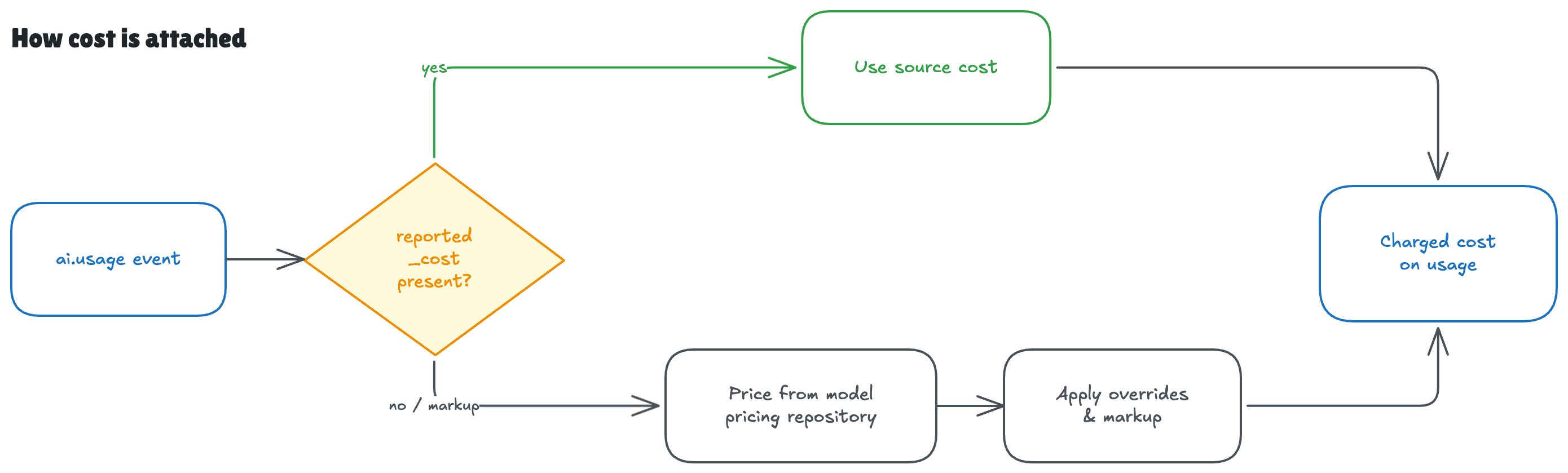
Most modern gateways compute USD cost themselves, so Flexprice uses that by default and re-prices only when it needs to.
* **Trust the source cost (default)** — when `reported_cost` is present (LiteLLM, OpenRouter, Portkey, Langfuse, Helicone, Cloudflare, Vercel), Flexprice stores it as-is. This correctly captures negotiated and BYOK rates.
* **Re-price from the catalog** — when a source provides **tokens only** (Bedrock logs, Databricks token usage) or you want **markup/margin** or a **single normalised price** across gateways, Flexprice prices from its model pricing repository.
The **public model pricing repository is refreshed daily**, so popular provider/model rates are available out of the box. Override any rate per provider, model, or customer for committed pricing, and apply a markup factor when reselling.
You provide read-only credentials once; Flexprice stores them securely and runs the schedule. A per-source **watermark** plus `request_id` **dedupe** guarantees no double counting across overlapping pulls.
## Integrating LiteLLM
LiteLLM is a real-time **push** source: it fires a logging callback on every completion, already carrying token counts, USD cost, model, and identity. There are three ways to wire it into Flexprice — from drop-in to fully custom — and **all three emit the same standardised `ai.usage` event**. You never define meters, features, or prices for this; enabling the LiteLLM connector with a [template](#auto-provisioning-metering) provisions them.
### Option 1 — Flexprice SDK callback (recommended)
Register the Flexprice callback and you're done — no payload mapping, no transform to maintain. Every `completion()` call you already make is metered.
```python theme={null}
import litellm
from flexprice.litellm import FlexpriceLogger
litellm.callbacks = [
FlexpriceLogger(
api_key="",
# which LiteLLM identity becomes the Flexprice billing entity
entity_from="metadata.user_api_key_team_id",
)
]
# nothing else changes — usage now flows to Flexprice on every call
litellm.completion(
model="anthropic/claude-opus-4-8",
messages=[{"role": "user", "content": "Summarise this ticket"}],
metadata={"user_api_key_team_id": "team_platform", "user_api_key_user_id": "u_91"},
)
```
The callback reads LiteLLM's per-request record, maps it to `ai.usage`, and ships it — one event per request, attributed to the team (with the user kept as a child for per-user and per-agent visibility).
### Option 2 — LiteLLM Proxy (no code)
If you run the LiteLLM **Proxy**, enable the Flexprice callback in `config.yaml`. Every request routed through the proxy — from any app, agent, or MCP server — is metered and attributed to the virtual key's team/user, with nothing to deploy in your services.
```yaml theme={null}
litellm_settings:
callbacks: ["flexprice"]
environment_variables:
FLEXPRICE_API_KEY: ""
# map a LiteLLM virtual-key dimension to the billing entity
FLEXPRICE_ENTITY_FROM: "metadata.user_api_key_team_id"
```
When usage must stay inside your network, point LiteLLM's logging webhook at your in-infra [Flexprice Collector](/docs/collectors/overview) instead — the collector applies the same transform before anything leaves your VPC.
### Option 3 — Custom callback (full control)
When you want to shape the event yourself — add tags, override the entity, or filter calls — implement a LiteLLM `CustomLogger` and send the event with the Flexprice SDK. This is exactly what Option 1 does under the hood, exposed for you to customise.
```python theme={null}
from litellm.integrations.custom_logger import CustomLogger
import litellm
from flexprice import Flexprice
fp = Flexprice(api_key="")
class FlexpriceLogger(CustomLogger):
async def async_log_success_event(self, kwargs, response_obj, start_time, end_time):
# LiteLLM's normalised, per-request usage + cost record
slp = kwargs["standard_logging_object"]
meta = slp.get("metadata", {})
fp.events.ingest(
event_name="ai.usage",
external_customer_id=meta.get("user_api_key_team_id", "unknown"),
source="litellm",
properties={
"provider": slp["custom_llm_provider"],
"model": slp["model"],
"operation": "chat",
"input_tokens": slp["prompt_tokens"],
"output_tokens": slp["completion_tokens"],
"reported_cost": slp["response_cost"], # USD, computed by LiteLLM
"request_id": slp["id"],
"raw_user": meta.get("user_api_key_user_id"),
"raw_team": meta.get("user_api_key_team_id"),
},
)
litellm.callbacks = [FlexpriceLogger()]
```
### The event Flexprice receives
Whichever option you pick, the same canonical event lands — already mapped, ready to be priced and attributed:
```json theme={null}
{
"event_name": "ai.usage",
"external_customer_id": "team_platform",
"source": "litellm",
"properties": {
"provider": "anthropic",
"model": "claude-opus-4-8",
"operation": "chat",
"input_tokens": "1840",
"output_tokens": "320",
"reported_cost": "0.041",
"request_id": "req_abc123",
"raw_user": "u_91",
"raw_team": "team_platform"
}
}
```
If you'd rather not use an SDK at all, the same event can be posted directly to the [events API](/docs/event-ingestion/sending-events):
```bash theme={null}
curl -X POST https://api.cloud.flexprice.io/v1/events \
-H 'x-api-key: ' \
-H 'Content-Type: application/json' \
-d '{
"event_name": "ai.usage",
"external_customer_id": "team_platform",
"source": "litellm",
"properties": {
"provider": "anthropic", "model": "claude-opus-4-8",
"input_tokens": "1840", "output_tokens": "320",
"reported_cost": "0.041", "request_id": "req_abc123"
}
}'
```
### Closing the loop — enforcement
Because Flexprice now holds the source of truth for spend, a budget breach can act **back** on LiteLLM (the dashed return path in the push-flow diagram). On a `warning`/`critical` [alert](/docs/customers/threshold-notifications), Flexprice calls LiteLLM's management API with your master key to throttle the offending key or team:
```bash theme={null}
# soft: zero out the remaining budget on a key
curl -X POST https:///key/update \
-H 'Authorization: Bearer ' \
-H 'Content-Type: application/json' \
-d '{ "key": "", "max_budget": 0 }'
# hard: block the key outright
curl -X POST https:///key/block \
-H 'Authorization: Bearer ' \
-H 'Content-Type: application/json' \
-d '{ "key": "" }'
```
Start with soft alerts (webhooks/notifications) and graduate to hard enforcement once you trust the numbers.
## How cost is attached
Most modern gateways compute USD cost themselves, so Flexprice uses that by default and re-prices only when it needs to.
* **Trust the source cost (default)** — when `reported_cost` is present (LiteLLM, OpenRouter, Portkey, Langfuse, Helicone, Cloudflare, Vercel), Flexprice stores it as-is. This correctly captures negotiated and BYOK rates.
* **Re-price from the catalog** — when a source provides **tokens only** (Bedrock logs, Databricks token usage) or you want **markup/margin** or a **single normalised price** across gateways, Flexprice prices from its model pricing repository.
The **public model pricing repository is refreshed daily**, so popular provider/model rates are available out of the box. Override any rate per provider, model, or customer for committed pricing, and apply a markup factor when reselling.
 ## Auto-provisioning metering
Enabling a connector and choosing a **template** creates the metering graph for you — no manual meters, features, or prices.
* **`cost_tracking`** — meters for input/output/cached/reasoning tokens and request count, features per dimension, and catalog pricing at cost. For internal showback.
* **`team_budget`** — the above plus a wallet, a recurring monthly credit grant, and `info`/`warning`/`critical` [alerts](/docs/customers/threshold-notifications) wired to gateway enforcement. For team and agent budgets.
* **`resale_markup`** — catalog re-pricing with a configurable margin, plus margin analytics. For AI features you bill customers for.
Provider and model breakdowns come from filters and `group_by` on the `provider` and `model` properties, so there is no meter-per-model explosion — a handful of generic meters cover every model.
## Identity and hierarchy resolution
Each connector maps source identifiers to a Flexprice billing entity and, optionally, builds the hierarchy:
* A primary field (for example `raw_team`) resolves to the [customer](/docs/customers/overview) being metered.
* Additional fields (`raw_user`, `agent_id`) create child entities under it, using [Customer Hierarchy](/docs/subscriptions/customer-hierarchy) for individual visibility with consolidated rollups and shared wallets.
* Unrecognised identifiers can auto-create entities or map to an existing `external_id`.
This is what lets one wallet span an entire team while you still see each user's and agent's usage separately — and what powers per-agent ROI.
## Source coverage
Phase one deliberately spans every connector type so the model is proven against the hard cases:
| Source | Type | Cost basis | Notes |
| ------------------------- | --------------------------------- | ------------------- | ----------------------------------------------------------------- |
| **LiteLLM** | Push (or hosted webhook) | Source cost | Richest identity (key/user/team/org/tags); real-time. |
| **Langfuse** | Managed pull (observations API) | Source cost | No usage webhook upstream, so polled; near-real-time. |
| **AWS Bedrock** | Managed pull (S3 logs + CUR) | Catalog re-price | Per-request token logs; reconcile \$ against Cost & Usage Report. |
| **Databricks** | Managed pull (system tables, SQL) | Catalog re-price | DBU/token usage joined to list prices; hourly grain. |
| **Salesforce Agentforce** | Aggregate | Catalog (rate card) | Native units (credits/conversations); `fidelity: aggregate`. |
Coverage expands continuously — Helicone, OpenRouter, Portkey, Snowflake Cortex, TrueFoundry, Cloudflare, Vercel, and SAP Joule follow the same connector model. Each new source is a connector definition plus pricing entries, not a change to your setup.
Aggregate sources (such as Agentforce and SAP Joule) report coarse, native-unit totals rather than per-request tokens. Flexprice labels these with `fidelity: aggregate` so dashboards and alerts reflect the real granularity — treat per-agent ROI from these sources as approximate.
## Related
The problem, the solution, and the high-level architecture.
The Bento-based collector used for push and in-infra sources.
The underlying event pipeline AI usage rides on.
Spend thresholds, states, and webhook delivery.
## Auto-provisioning metering
Enabling a connector and choosing a **template** creates the metering graph for you — no manual meters, features, or prices.
* **`cost_tracking`** — meters for input/output/cached/reasoning tokens and request count, features per dimension, and catalog pricing at cost. For internal showback.
* **`team_budget`** — the above plus a wallet, a recurring monthly credit grant, and `info`/`warning`/`critical` [alerts](/docs/customers/threshold-notifications) wired to gateway enforcement. For team and agent budgets.
* **`resale_markup`** — catalog re-pricing with a configurable margin, plus margin analytics. For AI features you bill customers for.
Provider and model breakdowns come from filters and `group_by` on the `provider` and `model` properties, so there is no meter-per-model explosion — a handful of generic meters cover every model.
## Identity and hierarchy resolution
Each connector maps source identifiers to a Flexprice billing entity and, optionally, builds the hierarchy:
* A primary field (for example `raw_team`) resolves to the [customer](/docs/customers/overview) being metered.
* Additional fields (`raw_user`, `agent_id`) create child entities under it, using [Customer Hierarchy](/docs/subscriptions/customer-hierarchy) for individual visibility with consolidated rollups and shared wallets.
* Unrecognised identifiers can auto-create entities or map to an existing `external_id`.
This is what lets one wallet span an entire team while you still see each user's and agent's usage separately — and what powers per-agent ROI.
## Source coverage
Phase one deliberately spans every connector type so the model is proven against the hard cases:
| Source | Type | Cost basis | Notes |
| ------------------------- | --------------------------------- | ------------------- | ----------------------------------------------------------------- |
| **LiteLLM** | Push (or hosted webhook) | Source cost | Richest identity (key/user/team/org/tags); real-time. |
| **Langfuse** | Managed pull (observations API) | Source cost | No usage webhook upstream, so polled; near-real-time. |
| **AWS Bedrock** | Managed pull (S3 logs + CUR) | Catalog re-price | Per-request token logs; reconcile \$ against Cost & Usage Report. |
| **Databricks** | Managed pull (system tables, SQL) | Catalog re-price | DBU/token usage joined to list prices; hourly grain. |
| **Salesforce Agentforce** | Aggregate | Catalog (rate card) | Native units (credits/conversations); `fidelity: aggregate`. |
Coverage expands continuously — Helicone, OpenRouter, Portkey, Snowflake Cortex, TrueFoundry, Cloudflare, Vercel, and SAP Joule follow the same connector model. Each new source is a connector definition plus pricing entries, not a change to your setup.
Aggregate sources (such as Agentforce and SAP Joule) report coarse, native-unit totals rather than per-request tokens. Flexprice labels these with `fidelity: aggregate` so dashboards and alerts reflect the real granularity — treat per-agent ROI from these sources as approximate.
## Related
The problem, the solution, and the high-level architecture.
The Bento-based collector used for push and in-infra sources.
The underlying event pipeline AI usage rides on.
Spend thresholds, states, and webhook delivery.