> ## Documentation Index
> Fetch the complete documentation index at: https://docs.flexprice.io/llms.txt
> Use this file to discover all available pages before exploring further.
# Send Usage Events
> What to put in a Flexprice usage event, and how to deliver events so each one is counted exactly once: durable queues, safe retries, and idempotent IDs
Usage events are the input to usage-based billing in Flexprice. Your application sends an event each time a customer uses something you bill for, and metered features aggregate those events into the quantity on each invoice line. A lost event is lost revenue, and an event counted twice is an overcharge. This page covers what to put in a usage event and how to deliver events so that each one is counted exactly once.
Send usage events with the [Ingest event](/api-reference/events/ingest-event) and [Bulk ingest events](/api-reference/events/bulk-ingest-events) endpoints, the [SDKs](/developers/sdks/usage), or the [Flexprice Collector](/docs/collectors/overview) when events already flow through a stream such as Kafka. For requests, code samples, and responses, see [Send Usage Events with the API and SDKs](/docs/core-concepts/usage-events/sending-events).
## Usage event structure
A usage event is a JSON object:
```json theme={null}
{
"event_name": "api_request", // required: a feature's event name
"external_customer_id": "cust_123", // required: your customer ID
"event_id": "req_9f3c", // recommended: unique per usage
"timestamp": "2026-10-10T14:03:00Z", // recommended: when it happened
"properties": { // values features aggregate
"bytes": 1024,
"region": "us-east-1"
},
"source": "api-gateway" // optional: the sending system
}
```
* **`event_name`**
Flexprice counts the event toward the metered features whose event name matches it exactly, including case. An event whose name matches no feature is still accepted with `202`, so a typo fails silently. A feature's event name can't be changed after the feature is created.
* **`external_customer_id`**
Your identifier for the customer: the same value as the customer's External ID in Flexprice. Events for an external ID that has no customer yet are stored, and count once a customer with that External ID exists. See [Sending usage events before the customer exists](#sending-usage-events-before-the-customer-exists).
* **`event_id`**
A unique ID for this piece of usage. Flexprice generates one when you leave it out, but set your own from the usage itself, such as a request ID or a job ID, so that a resent event carries the same ID. Together with `timestamp`, it's how Flexprice recognizes a copy of an event. See [Making usage events idempotent](#making-usage-events-idempotent).
* **`timestamp`**
When the usage happened, as an [RFC 3339](https://www.rfc-editor.org/rfc/rfc3339) string with a timezone, such as `2026-10-10T14:03:00Z` or `2026-10-10T19:33:00+05:30`. A timestamp in any other format, or without a timezone, fails the whole request with `400`. Flexprice stores the time in UTC and uses it to place the usage in a billing period. When you leave it out, Flexprice uses the time it received the request, so a retried event gets a new timestamp and counts twice. There is no limit on how old a timestamp can be, which is how [backfills](/docs/core-concepts/usage-events/backfill) work.
* **`properties`**
Key-value pairs that features aggregate (Sum, Max, Latest, and the other [aggregation types](/docs/product-catalogue/features/aggregation/overview)) and filter on. Send numeric values as JSON numbers or numeric strings. A missing or non-numeric value counts as `0`, and so does a negative value. Send more properties than your pricing uses today, such as region or model: a feature added later can only filter on properties that the events already carry.
* **`source`**
Free text naming the system that sent the event. The [Event Debugger](/docs/event-ingestion/event-debugger) filters on it, which helps when several services send the same event name.
## Queuing and retrying usage events
If your service sends events inline and the call fails, or the process crashes before it sends, that usage is gone. Put each event on a durable queue such as Amazon SQS, Kafka, or RabbitMQ when the usage happens, with its `event_id` and `timestamp` already set, and have a worker send events from the queue to Flexprice.
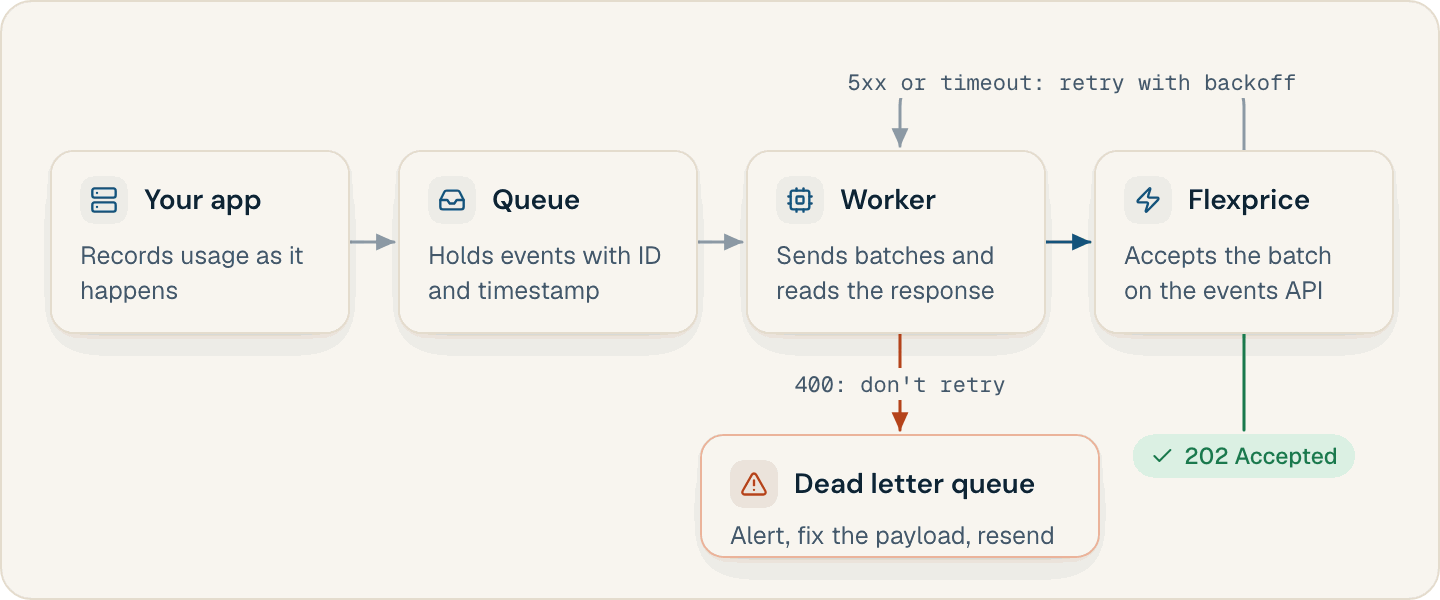
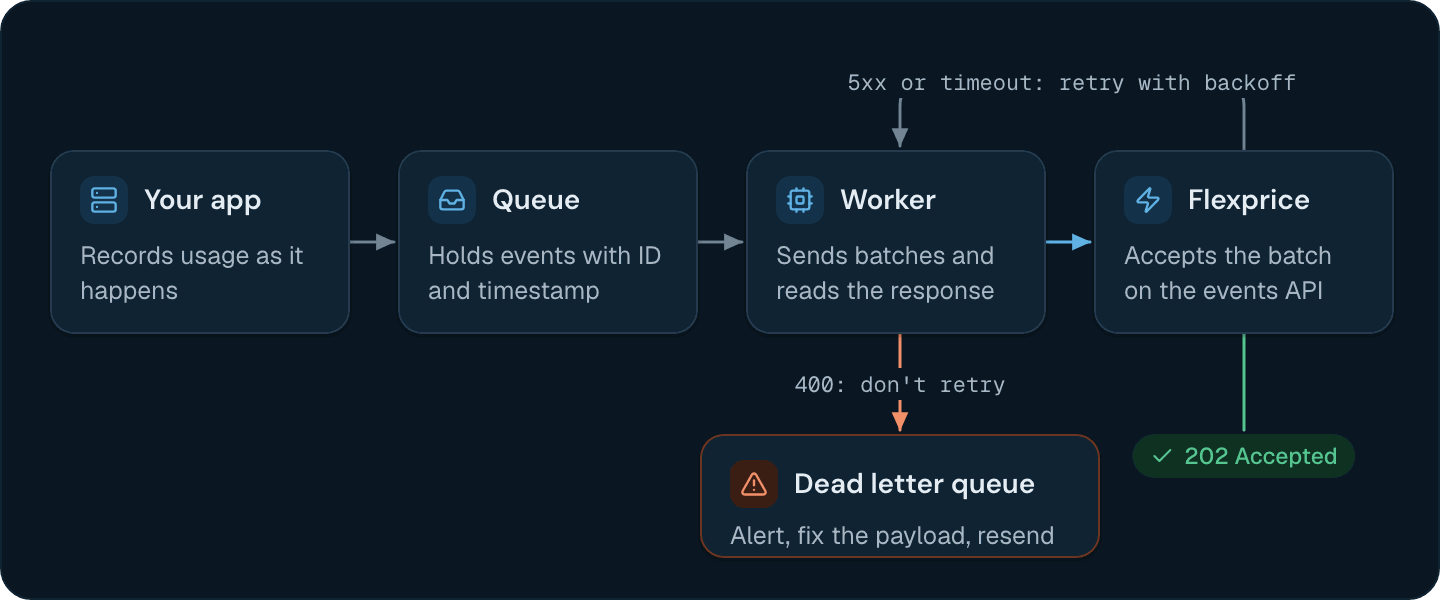 * **Retry network errors, timeouts, and `5xx` responses** with exponential backoff until you get `202`. Resend the whole request: copies of an event that share its `event_id` and `timestamp` collapse into one.
* **Turn on SDK retries.** They are off by default in every SDK: see [Retrying failed SDK requests](/developers/sdks/usage#retrying-failed-sdk-requests).
* **Expect partly accepted bulk requests.** A `400` caused by one event missing a required field can arrive after earlier events in the same array were accepted. Fix that event and resend the whole batch.
**Don't retry a `400` automatically.** The payload fails the same way every time. Move the event to a dead letter queue, raise an alert, and fix the payload before you resend it.
## Making usage events idempotent
The same usage often reaches Flexprice more than once: a retry after a timeout, a queue that redelivers a message, a heartbeat that fires twice. Flexprice collapses copies of an event into one when they carry the same `event_id` and `timestamp`, so set both on every event:
* **Set both when the usage happens.** Store them with the event in your queue, and never regenerate either one on a retry.
* **Derive `event_id` from the usage, not from the attempt to send it:** an API gateway's request ID, a batch job's ID plus its chunk number, or an LLM provider's response ID.
* **Never leave either field out.** Flexprice fills in a missing `event_id` or `timestamp` with a new value for each copy, so a resent copy counts again.
* **Retry network errors, timeouts, and `5xx` responses** with exponential backoff until you get `202`. Resend the whole request: copies of an event that share its `event_id` and `timestamp` collapse into one.
* **Turn on SDK retries.** They are off by default in every SDK: see [Retrying failed SDK requests](/developers/sdks/usage#retrying-failed-sdk-requests).
* **Expect partly accepted bulk requests.** A `400` caused by one event missing a required field can arrive after earlier events in the same array were accepted. Fix that event and resend the whole batch.
**Don't retry a `400` automatically.** The payload fails the same way every time. Move the event to a dead letter queue, raise an alert, and fix the payload before you resend it.
## Making usage events idempotent
The same usage often reaches Flexprice more than once: a retry after a timeout, a queue that redelivers a message, a heartbeat that fires twice. Flexprice collapses copies of an event into one when they carry the same `event_id` and `timestamp`, so set both on every event:
* **Set both when the usage happens.** Store them with the event in your queue, and never regenerate either one on a retry.
* **Derive `event_id` from the usage, not from the attempt to send it:** an API gateway's request ID, a batch job's ID plus its chunk number, or an LLM provider's response ID.
* **Never leave either field out.** Flexprice fills in a missing `event_id` or `timestamp` with a new value for each copy, so a resent copy counts again.
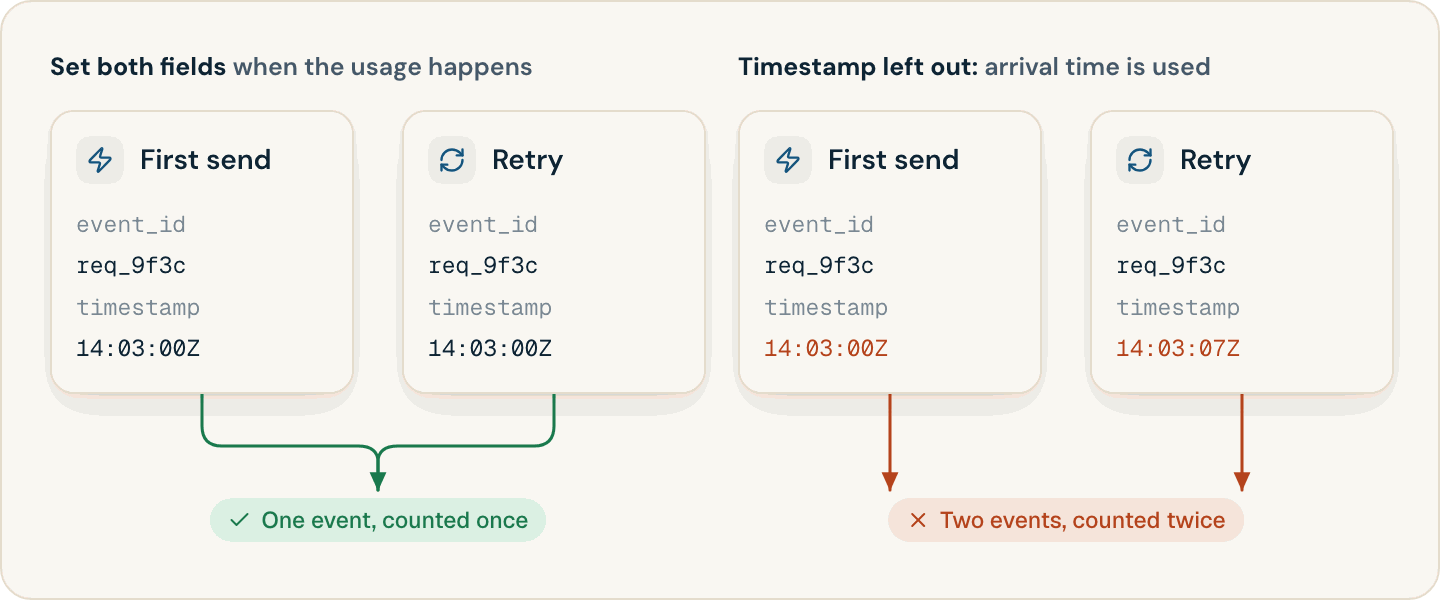
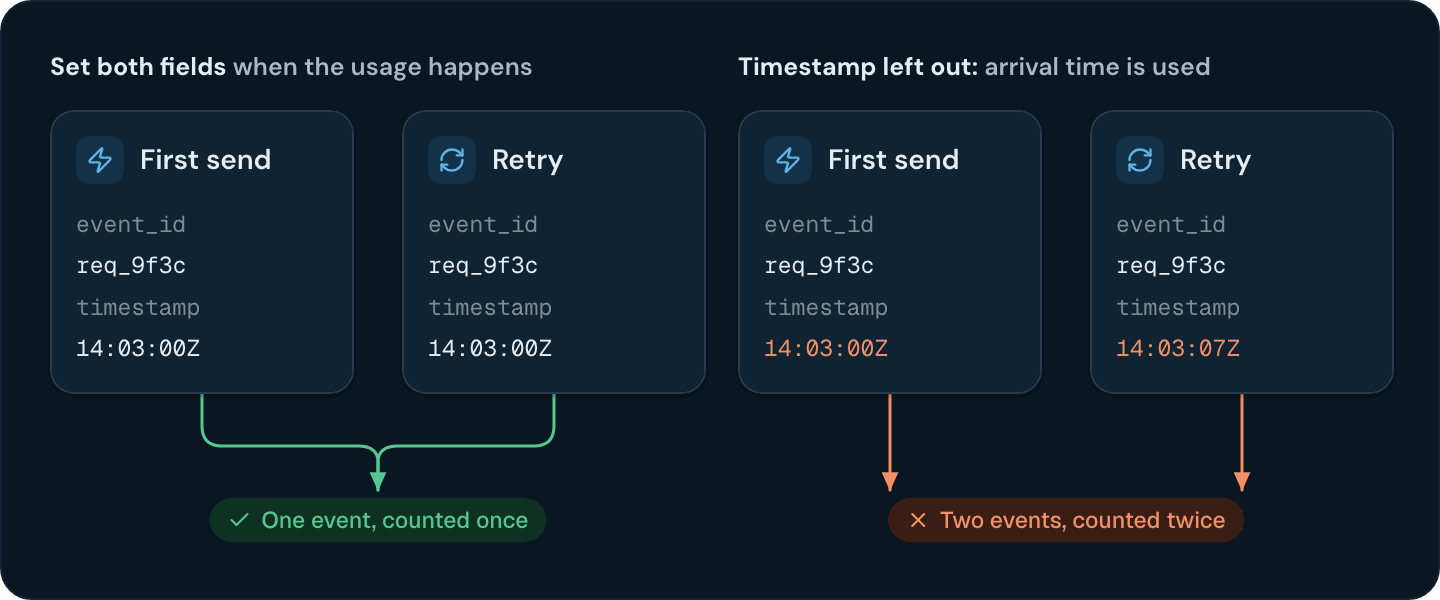 The API accepts every copy with `202`, and copies collapse later, in storage. [Idempotency and Deduplication](/docs/core-concepts/usage-events/idempotency) covers what happens when either field is missing and where a copy can show up before it collapses.
### Making heartbeat events idempotent
Some usage events report state on a schedule instead of an action: a node reporting its CPU cores every minute, or a nightly snapshot of storage. Make every heartbeat sent in the same measurement period a copy of the same event. Build the `event_id` from the source and the start of the period, and set `timestamp` to that same period start:
```text theme={null}
event_id: _
timestamp: that minute as RFC 3339, such as 2026-10-10T14:03:00Z
```
Round the timestamp as well as the ID. A timestamp read from the clock at send time differs between two heartbeats in the same minute, so both count. With both rounded, send two or more heartbeats per period: the extra copies collapse, and a delayed timer no longer leaves a period unbilled. See [Making heartbeat events idempotent](/docs/core-concepts/usage-events/idempotency#making-heartbeat-events-idempotent) for a full example.
## Logging the usage events you send
Log every event your worker sends, with the response status, while you integrate and after any change to your events. That log is your record of what Flexprice received: compare it with the Event Debugger or usage analytics when a count looks wrong.
## Sending usage events before the customer exists
Flexprice stores events for an `external_customer_id` that has no customer yet, and counts them once a customer with that External ID exists. Signup in your product doesn't have to wait for Flexprice: create the customer in your own system, start sending usage, and create the Flexprice customer asynchronously. The usage is billed once the customer has a subscription whose billing period covers each event's timestamp.
## Changing the shape of usage events
A feature counts only the events whose `event_name` and aggregated property match its configuration exactly. Renaming either one in your code silently stops the feature from counting, because Flexprice keeps accepting the renamed events with `202`. Before you change an event, set up the feature that will count the new shape, then confirm in the Event Debugger that the new events are counted.
Authentication, single and bulk requests, and the responses to handle.
How Flexprice recognizes a copy of an event, and how to make retries and heartbeats safe.
Batch events with the bulk endpoint, the SDKs, or the Flexprice Collector.
Load historical usage and get it onto draft or finalized invoices.
This documentation is built and hosted on [Mintlify](https://mintlify.com), a developer documentation platform.
The API accepts every copy with `202`, and copies collapse later, in storage. [Idempotency and Deduplication](/docs/core-concepts/usage-events/idempotency) covers what happens when either field is missing and where a copy can show up before it collapses.
### Making heartbeat events idempotent
Some usage events report state on a schedule instead of an action: a node reporting its CPU cores every minute, or a nightly snapshot of storage. Make every heartbeat sent in the same measurement period a copy of the same event. Build the `event_id` from the source and the start of the period, and set `timestamp` to that same period start:
```text theme={null}
event_id: _
timestamp: that minute as RFC 3339, such as 2026-10-10T14:03:00Z
```
Round the timestamp as well as the ID. A timestamp read from the clock at send time differs between two heartbeats in the same minute, so both count. With both rounded, send two or more heartbeats per period: the extra copies collapse, and a delayed timer no longer leaves a period unbilled. See [Making heartbeat events idempotent](/docs/core-concepts/usage-events/idempotency#making-heartbeat-events-idempotent) for a full example.
## Logging the usage events you send
Log every event your worker sends, with the response status, while you integrate and after any change to your events. That log is your record of what Flexprice received: compare it with the Event Debugger or usage analytics when a count looks wrong.
## Sending usage events before the customer exists
Flexprice stores events for an `external_customer_id` that has no customer yet, and counts them once a customer with that External ID exists. Signup in your product doesn't have to wait for Flexprice: create the customer in your own system, start sending usage, and create the Flexprice customer asynchronously. The usage is billed once the customer has a subscription whose billing period covers each event's timestamp.
## Changing the shape of usage events
A feature counts only the events whose `event_name` and aggregated property match its configuration exactly. Renaming either one in your code silently stops the feature from counting, because Flexprice keeps accepting the renamed events with `202`. Before you change an event, set up the feature that will count the new shape, then confirm in the Event Debugger that the new events are counted.
Authentication, single and bulk requests, and the responses to handle.
How Flexprice recognizes a copy of an event, and how to make retries and heartbeats safe.
Batch events with the bulk endpoint, the SDKs, or the Flexprice Collector.
Load historical usage and get it onto draft or finalized invoices.
This documentation is built and hosted on [Mintlify](https://mintlify.com), a developer documentation platform.