> ## Documentation Index
> Fetch the complete documentation index at: https://docs.flexprice.io/llms.txt
> Use this file to discover all available pages before exploring further.
# How to launch new products
> Use scenarios to de-risk first-time monetization and turn pricing into a growth lever
Monetizing new experiences is all about value capture and alignment. Scenarios help you navigate first-time monetization or evolve your pricing as your product matures, without real-world billing risk.
## Early-stage products: transitioning from legacy pricing
The shift from legacy subscription pricing to usage-first monetization requires careful risk management. If you've launched a new AI feature or agent, folding this functionality into the price of an existing seat-based subscription won't scale. As adoption grows, so do your costs.
Introduce usage-first pricing via a scenario hypothesis. This lets you monitor product adoption and costs over time while building a business case for when and how to price a new product. Common starting points include:
* **Standalone pricing**: charge for the new product directly to de-risk the rest of your offerings
* **Hybrid pricing**: reduce fixed fees alongside usage-based pricing to lower the barrier to entry while maintaining repeatable revenue
 ## Growth-stage products: finding your value metric
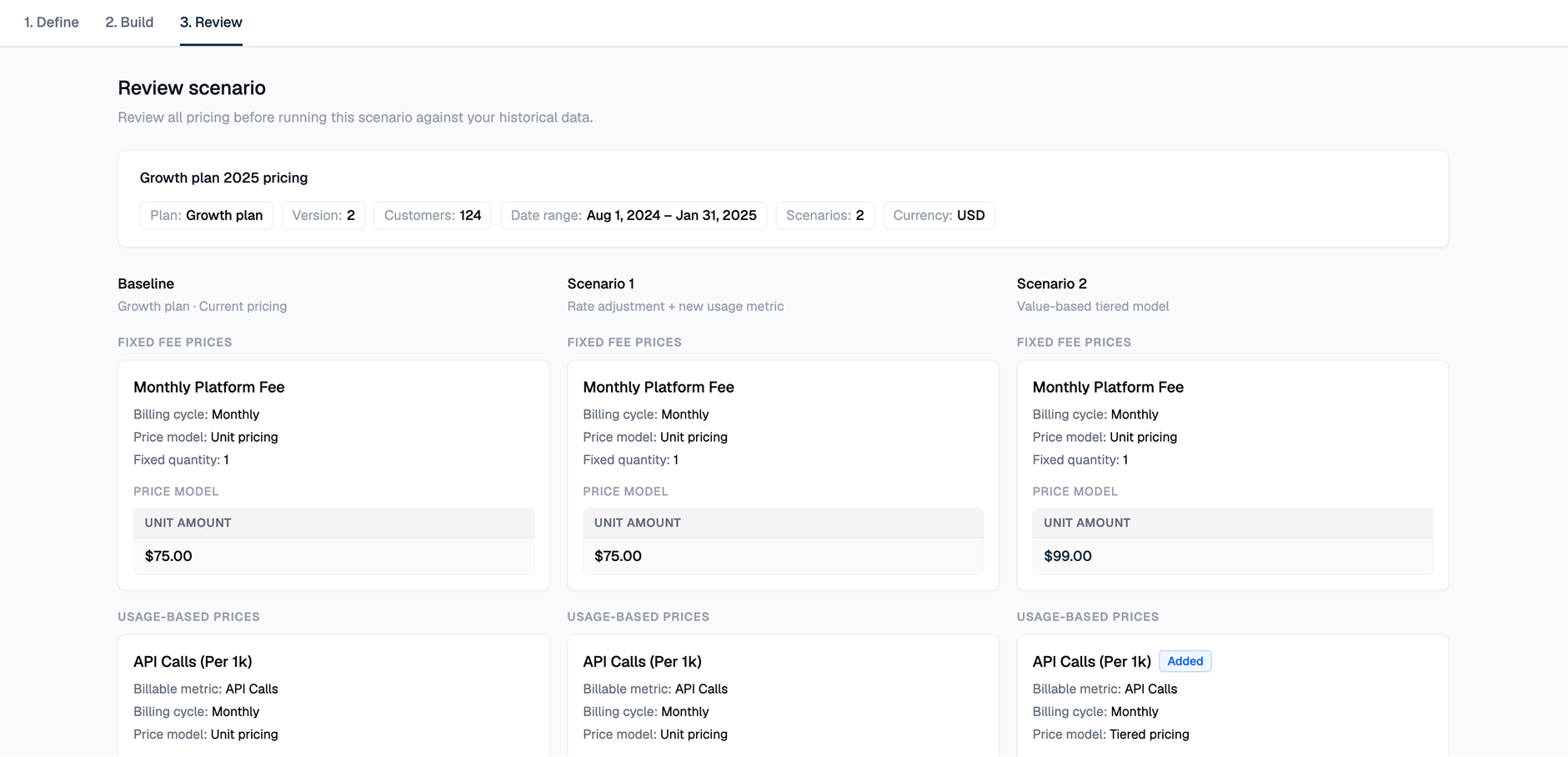
For products entering the growth and scale stage, monetization is about aligning pricing with the value your product delivers. For AI builders especially, this means evaluating and transitioning across different metric types:
* **Cost-centric**: pricing is directly tied to unit economics. In early stages, the cost of using your product is passed through to customers.
* **Usage-first**: pricing is tied to overall adoption and usage. Typically commands a higher rate than cost-centric pricing.
* **Value-based / outcome-based**: pricing is tied to outcomes and product value. When your customers win, you win. This commands the highest price point and encourages further product use.
In Flexprice Scenarios, model each metric type as a separate hypothesis. Comparing results side by side surfaces the differences, implications, and tradeoffs of each pricing approach, without any real-world consequences.
## Growth-stage products: finding your value metric
For products entering the growth and scale stage, monetization is about aligning pricing with the value your product delivers. For AI builders especially, this means evaluating and transitioning across different metric types:
* **Cost-centric**: pricing is directly tied to unit economics. In early stages, the cost of using your product is passed through to customers.
* **Usage-first**: pricing is tied to overall adoption and usage. Typically commands a higher rate than cost-centric pricing.
* **Value-based / outcome-based**: pricing is tied to outcomes and product value. When your customers win, you win. This commands the highest price point and encourages further product use.
In Flexprice Scenarios, model each metric type as a separate hypothesis. Comparing results side by side surfaces the differences, implications, and tradeoffs of each pricing approach, without any real-world consequences.
 ## Mature products: tuning rates to the market
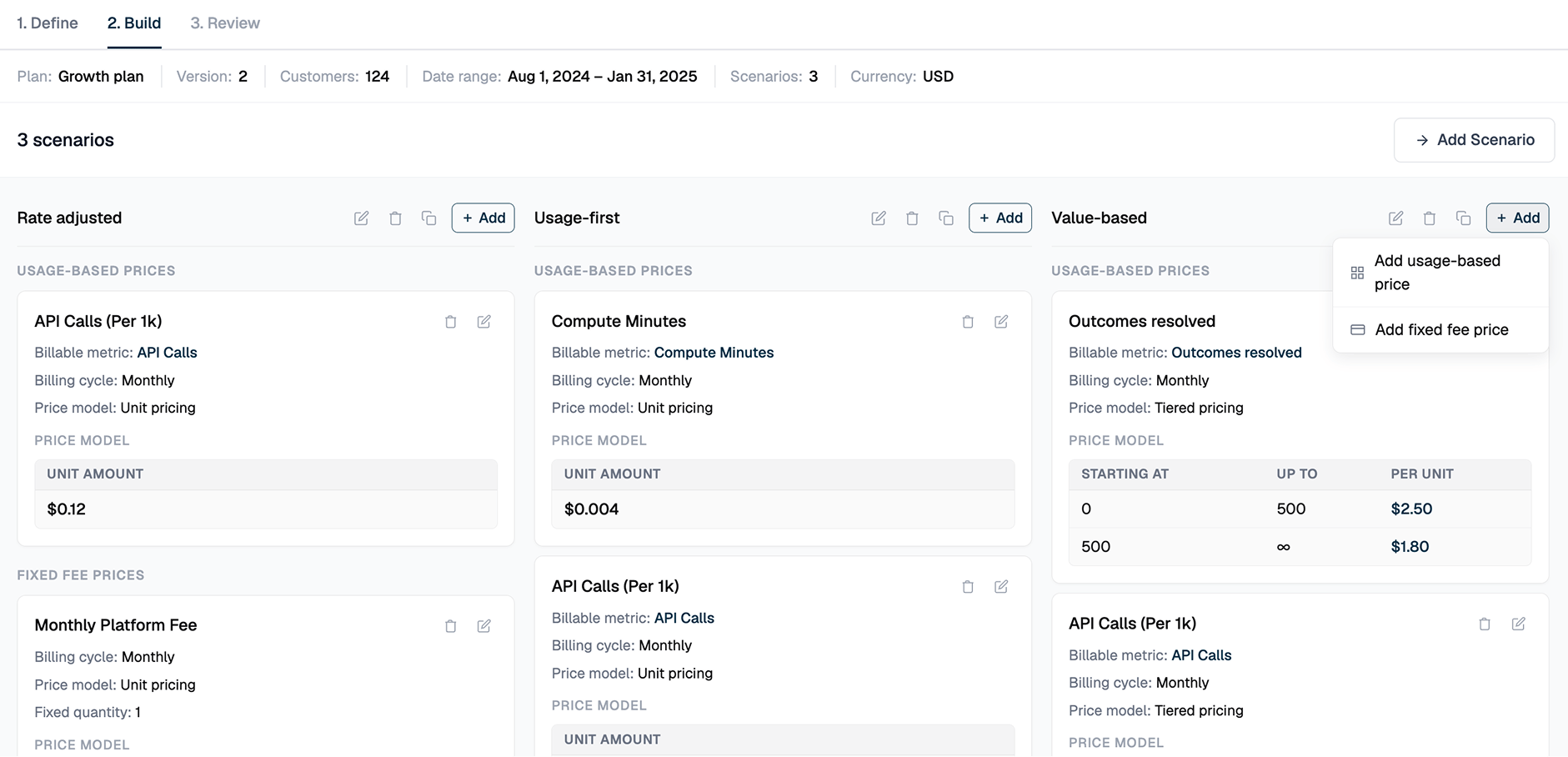
Even for established products, changing market conditions and competitive pressure require constant pricing refinement.
Copy your existing pricing into a hypothesis to preserve a baseline for comparison.
Edit the individual rate or change the pricing model on the hypothesis.
Duplicate the hypothesis to model additional changes side by side.
## Mature products: tuning rates to the market
Even for established products, changing market conditions and competitive pressure require constant pricing refinement.
Copy your existing pricing into a hypothesis to preserve a baseline for comparison.
Edit the individual rate or change the pricing model on the hypothesis.
Duplicate the hypothesis to model additional changes side by side.
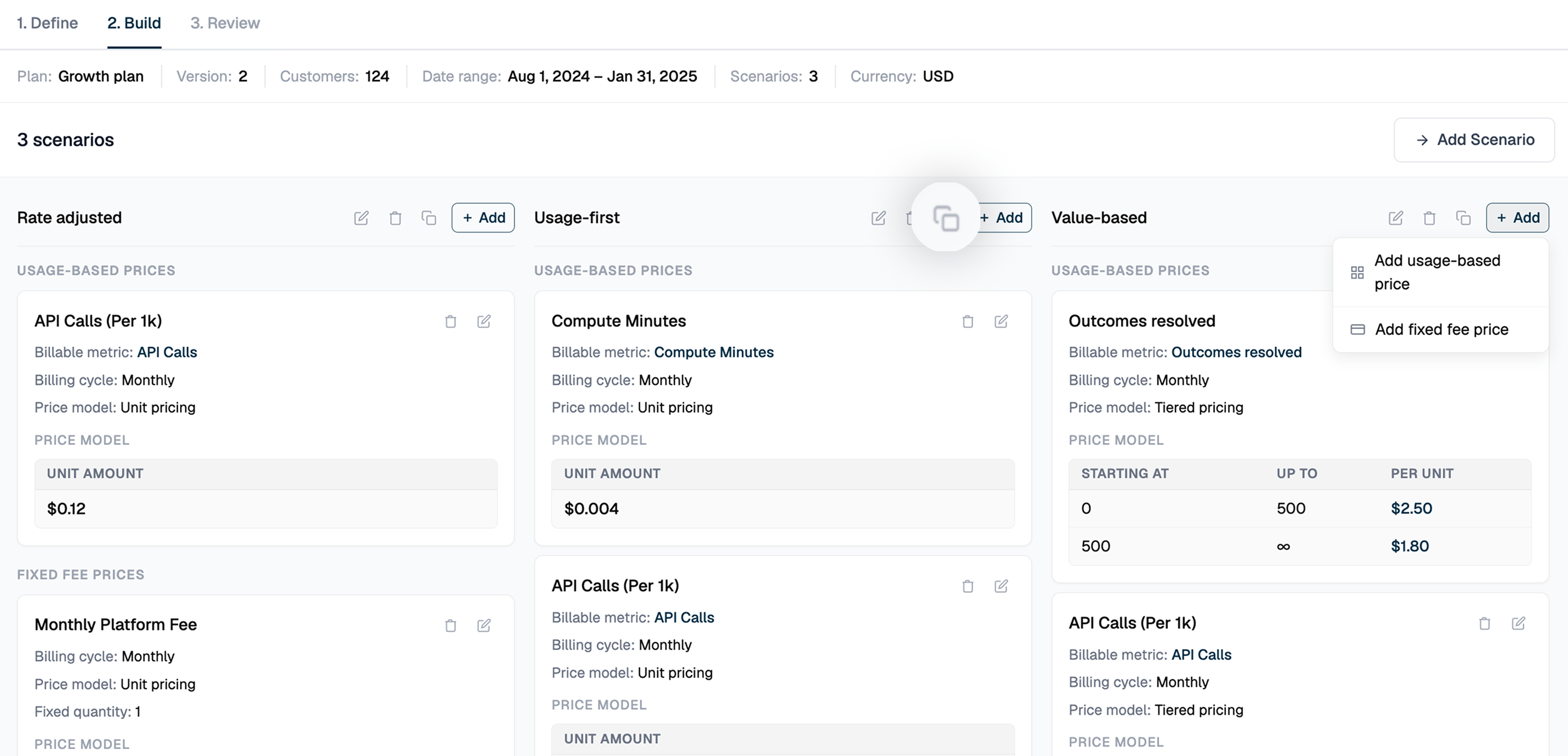 These tools let you quickly test new pricing hypotheses and experiment with your model, all grounded in real historical data.