> ## Documentation Index
> Fetch the complete documentation index at: https://docs.flexprice.io/llms.txt
> Use this file to discover all available pages before exploring further.
# Attio Customer Sync
> How Flexprice creates or links a customer for the company on each won Attio deal
Customer sync turns the companies on your won Attio deals into Flexprice customers. When a deal reaches the won stage set on the [Attio connection](/integrations/attio/connection-setup), Flexprice reads the deal's company and people, then creates or links one Flexprice customer for the company. Customer sync runs one way: Flexprice never creates or updates companies or people in Attio. Turn it on with the **Customers** toggle, or with `sync_config.customer.inbound` in the API.
## When Attio customer sync runs
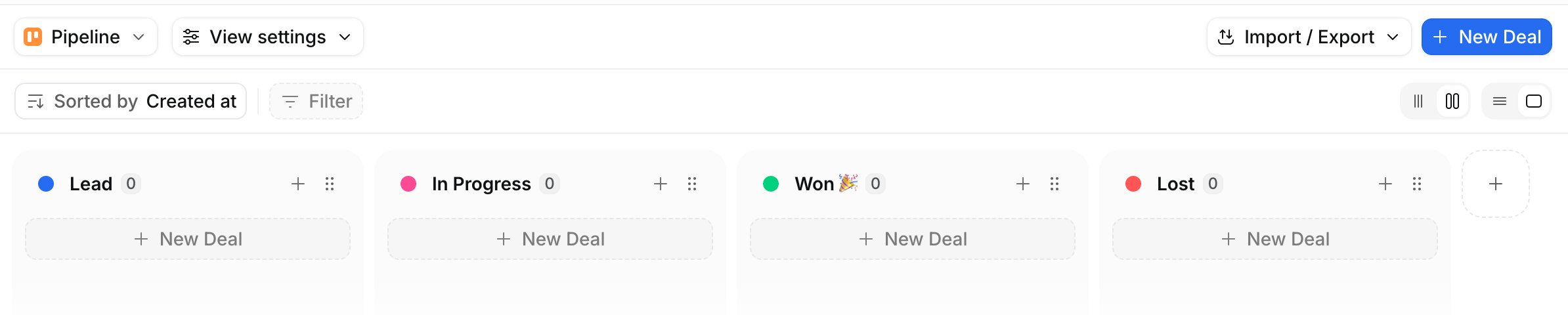
Customer sync starts when Attio sends a deal event to the webhook that Flexprice registers for the connection. See [How Flexprice receives Attio deal events](/integrations/attio/connection-setup#how-flexprice-receives-attio-deal-events). With Attio's default pipeline, moving a deal into the **Won 🎉** column starts customer sync.
 | Attio event | Result |
| - | - |
| A deal's stage changes to the won stage | Flexprice imports the deal |
| A deal is created in the won stage | Flexprice imports the deal |
| A deal moves to any other stage, or is created in another stage | Ignored |
| A won deal moves back out of the won stage, or is deleted | Ignored. The customer and its subscriptions stay as they are. |
* **One customer per company.** Every won deal for the same company links to the same customer.
* **A deal with neither a company nor a person** creates nothing.
## How Flexprice picks the company and billing contact
Flexprice reads two attributes on the won deal:
| Deal attribute | What Flexprice uses it for |
| - | - |
| `associated_company` | The company that becomes the Flexprice customer |
| `associated_people` | The billing contact: the first person listed who has an email address |
If the deal has no associated company, Flexprice creates the customer from the billing contact instead, as described in [Customers created from a person](#customers-created-from-a-person).
The billing contact's email address becomes the customer's email in Flexprice. List the person who handles billing first under **Associated people** on the deal, or make sure they are the first person with an email address.
## How Flexprice matches Attio companies to customers
Flexprice checks each won deal in this order:
1. **Company already linked.** If a Flexprice customer is already linked to the deal's company, Flexprice does not create another one. It sets the customer's `attio_deal_id` to the newly won deal, so the customer's next subscription syncs to that deal.
2. **Same email.** If a Flexprice customer has the billing contact's email address, Flexprice links that customer to the company and adds the Attio metadata keys. It leaves the customer's name and address unchanged.
3. **New customer.** Otherwise, Flexprice creates a customer from the company, as described in the next section.
## Attio fields copied to Flexprice customers
A customer created from an Attio company gets these values:
| Flexprice customer field | Value from Attio |
| - | - |
| `external_id` | The company's record ID |
| `name` | The company's `name` |
| `email` | The billing contact's first address in `email_addresses` |
| `address_line1` | `line_1` of the company's `primary_location` |
| `address_line2` | `line_2` of `primary_location` |
| `address_city` | `locality` of `primary_location` |
| `address_state` | `region` of `primary_location` |
| `address_postal_code` | `postcode` of `primary_location` |
| `address_country` | `country_code` of `primary_location` |
| `metadata.attio_company_id` | The company's record ID |
| `metadata.attio_person_id` | The billing contact's record ID |
| `metadata.attio_deal_id` | The record ID of the deal that triggered the import |
| `metadata.source` | `attio` |
Attio stores `country_code` as a two-letter ISO 3166-1 code, the format Flexprice expects, so the country maps without conversion. Fields that are empty in Attio stay empty on the customer.
| Attio event | Result |
| - | - |
| A deal's stage changes to the won stage | Flexprice imports the deal |
| A deal is created in the won stage | Flexprice imports the deal |
| A deal moves to any other stage, or is created in another stage | Ignored |
| A won deal moves back out of the won stage, or is deleted | Ignored. The customer and its subscriptions stay as they are. |
* **One customer per company.** Every won deal for the same company links to the same customer.
* **A deal with neither a company nor a person** creates nothing.
## How Flexprice picks the company and billing contact
Flexprice reads two attributes on the won deal:
| Deal attribute | What Flexprice uses it for |
| - | - |
| `associated_company` | The company that becomes the Flexprice customer |
| `associated_people` | The billing contact: the first person listed who has an email address |
If the deal has no associated company, Flexprice creates the customer from the billing contact instead, as described in [Customers created from a person](#customers-created-from-a-person).
The billing contact's email address becomes the customer's email in Flexprice. List the person who handles billing first under **Associated people** on the deal, or make sure they are the first person with an email address.
## How Flexprice matches Attio companies to customers
Flexprice checks each won deal in this order:
1. **Company already linked.** If a Flexprice customer is already linked to the deal's company, Flexprice does not create another one. It sets the customer's `attio_deal_id` to the newly won deal, so the customer's next subscription syncs to that deal.
2. **Same email.** If a Flexprice customer has the billing contact's email address, Flexprice links that customer to the company and adds the Attio metadata keys. It leaves the customer's name and address unchanged.
3. **New customer.** Otherwise, Flexprice creates a customer from the company, as described in the next section.
## Attio fields copied to Flexprice customers
A customer created from an Attio company gets these values:
| Flexprice customer field | Value from Attio |
| - | - |
| `external_id` | The company's record ID |
| `name` | The company's `name` |
| `email` | The billing contact's first address in `email_addresses` |
| `address_line1` | `line_1` of the company's `primary_location` |
| `address_line2` | `line_2` of `primary_location` |
| `address_city` | `locality` of `primary_location` |
| `address_state` | `region` of `primary_location` |
| `address_postal_code` | `postcode` of `primary_location` |
| `address_country` | `country_code` of `primary_location` |
| `metadata.attio_company_id` | The company's record ID |
| `metadata.attio_person_id` | The billing contact's record ID |
| `metadata.attio_deal_id` | The record ID of the deal that triggered the import |
| `metadata.source` | `attio` |
Attio stores `country_code` as a two-letter ISO 3166-1 code, the format Flexprice expects, so the country maps without conversion. Fields that are empty in Attio stay empty on the customer.
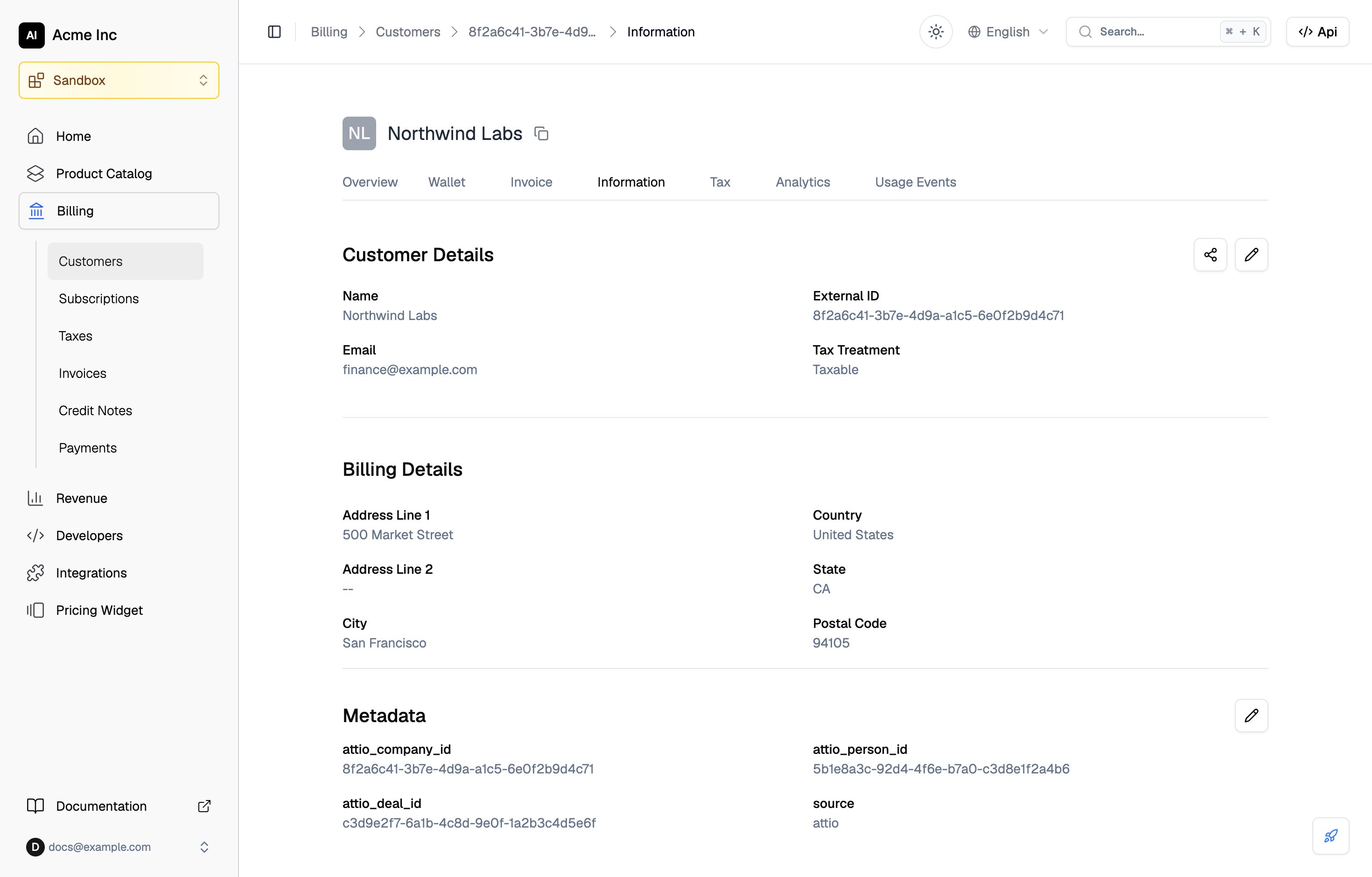 Later changes to the company or the billing contact in Attio are not copied to the Flexprice customer.
### Customers created from a person
When the won deal has no associated company, the customer is built from the billing contact:
| Flexprice customer field | Value from Attio |
| - | - |
| `external_id` | The person's record ID |
| `name` | The person's `full_name` |
| `email` | The person's first address in `email_addresses` |
| Address fields | The person's `primary_location`, mapped as in the table above |
| `metadata.attio_person_id` | The person's record ID |
| `metadata.attio_deal_id` | The record ID of the deal that triggered the import |
| `metadata.source` | `attio` |
Flexprice matches these customers on the person's record ID instead of a company's.
## Finding the Attio record linked to a customer
Customers created by customer sync carry the company ID in `metadata.attio_company_id`. For any linked customer, including customers linked by email, call [Get entity integration mappings](/api-reference/integrations/get-entity-integration-mappings):
```bash theme={null}
curl "https://api.cloud.flexprice.io/v1/integrations/mappings?entity_type=customer&entity_id=" \
-H "x-api-key: " \
-H "X-Environment-ID: "
```
The Attio link is the item with `provider_type` set to `attio`. Its `provider_entity_id` is the Attio company record ID, or the person record ID for a customer created from a person.
## Troubleshooting Attio customer sync
| Issue | Cause | Solution |
| - | - | - |
| A won deal created no customer | The deal reached a stage other than **Won Stage**, **Customers** is off, or the deal has no company and no person | Check **Won Stage** and the **Customers** toggle on the connection, and associate a company with the deal |
| The customer has no email | No person on the deal had an email address when it was won | Set the customer's email in Flexprice. Later changes in Attio are not copied. |
| The wrong person is the billing contact | Flexprice uses the first person with an email address under **Associated people** | Change the customer's email in Flexprice, and reorder the deal's people for future deals |
| Two customers exist for one company | The deals point at two company records in Attio, such as duplicates created from different email domains | Merge the duplicate companies in Attio, then archive the extra customer in Flexprice |
| A returning company's new subscription syncs to its old deal | The subscription was created before the new deal was won | Move the subscription as described in [Moving a subscription to a different Attio deal](/integrations/attio/deal-sync#moving-a-subscription-to-a-different-attio-deal) |
This documentation is built and hosted on [Mintlify](https://mintlify.com), a developer documentation platform.
Later changes to the company or the billing contact in Attio are not copied to the Flexprice customer.
### Customers created from a person
When the won deal has no associated company, the customer is built from the billing contact:
| Flexprice customer field | Value from Attio |
| - | - |
| `external_id` | The person's record ID |
| `name` | The person's `full_name` |
| `email` | The person's first address in `email_addresses` |
| Address fields | The person's `primary_location`, mapped as in the table above |
| `metadata.attio_person_id` | The person's record ID |
| `metadata.attio_deal_id` | The record ID of the deal that triggered the import |
| `metadata.source` | `attio` |
Flexprice matches these customers on the person's record ID instead of a company's.
## Finding the Attio record linked to a customer
Customers created by customer sync carry the company ID in `metadata.attio_company_id`. For any linked customer, including customers linked by email, call [Get entity integration mappings](/api-reference/integrations/get-entity-integration-mappings):
```bash theme={null}
curl "https://api.cloud.flexprice.io/v1/integrations/mappings?entity_type=customer&entity_id=" \
-H "x-api-key: " \
-H "X-Environment-ID: "
```
The Attio link is the item with `provider_type` set to `attio`. Its `provider_entity_id` is the Attio company record ID, or the person record ID for a customer created from a person.
## Troubleshooting Attio customer sync
| Issue | Cause | Solution |
| - | - | - |
| A won deal created no customer | The deal reached a stage other than **Won Stage**, **Customers** is off, or the deal has no company and no person | Check **Won Stage** and the **Customers** toggle on the connection, and associate a company with the deal |
| The customer has no email | No person on the deal had an email address when it was won | Set the customer's email in Flexprice. Later changes in Attio are not copied. |
| The wrong person is the billing contact | Flexprice uses the first person with an email address under **Associated people** | Change the customer's email in Flexprice, and reorder the deal's people for future deals |
| Two customers exist for one company | The deals point at two company records in Attio, such as duplicates created from different email domains | Merge the duplicate companies in Attio, then archive the extra customer in Flexprice |
| A returning company's new subscription syncs to its old deal | The subscription was created before the new deal was won | Move the subscription as described in [Moving a subscription to a different Attio deal](/integrations/attio/deal-sync#moving-a-subscription-to-a-different-attio-deal) |
This documentation is built and hosted on [Mintlify](https://mintlify.com), a developer documentation platform.