

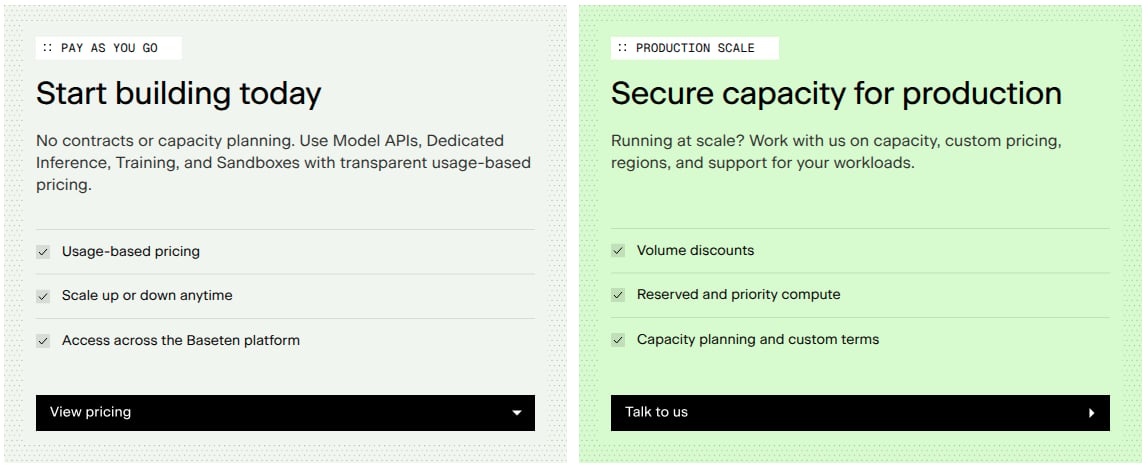
Baseten's complete purchasing-option cards, captured on November 12, 2026. The pay-as-you-go path is the context for this example; production-scale capacity, discounts and custom terms are not modeled.
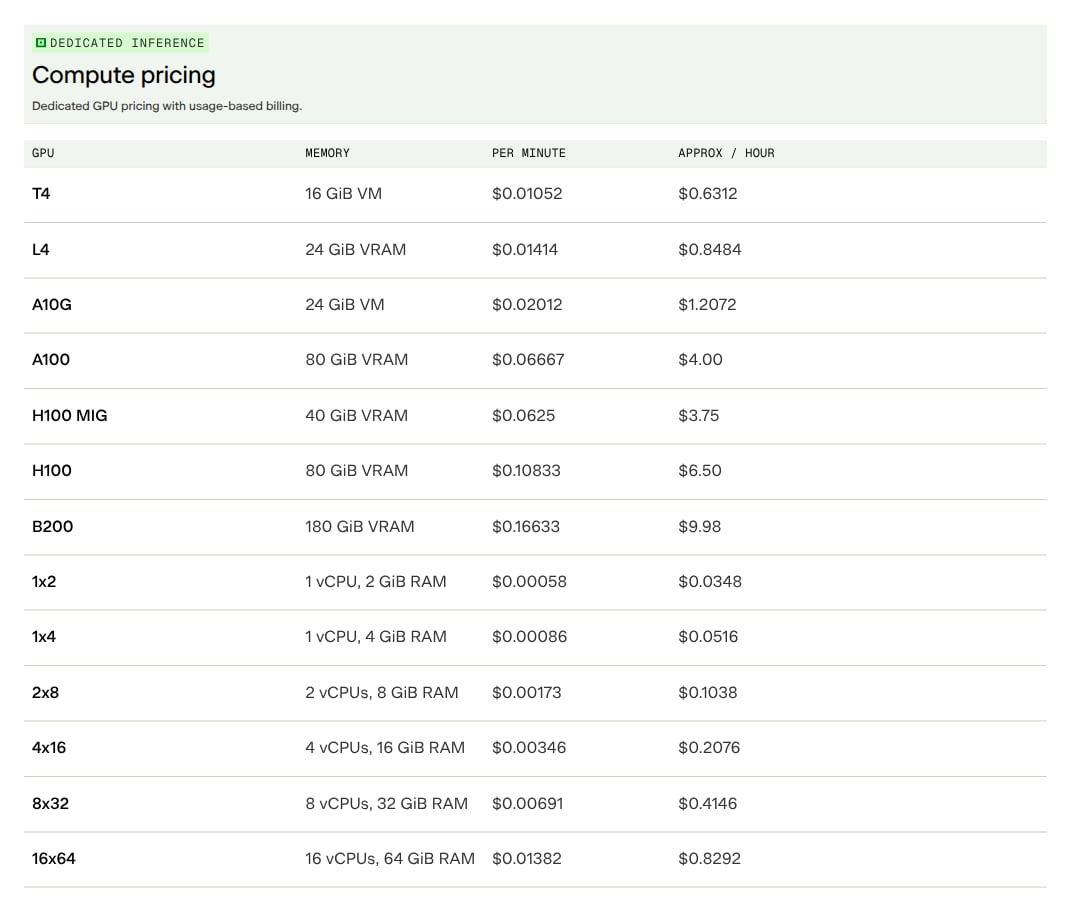
Baseten's complete Dedicated Inference compute comparison, captured on November 12, 2026. All hardware rows and both per-minute and approximate hourly columns are visible. Only the T4 row is modeled; other GPU and CPU shapes are comparison context.
This example calculates gross USD list-price charges for dedicated inference replicas using the T4 configuration. It excludes Model API tokens, training, other hardware, Sandboxes, storage, network charges, credits, discounts, tax and custom regions or contracts. Monthly arrears is the illustrative Flexprice billing cycle, not a claim about Baseten’s collection schedule. No live deployment or billing setup is executed.
Pricing profile
These labels describe the dedicated T4 inference offering, not every Baseten product or purchasing path.Published pricing and billing measure
Baseten defines a replica as an independent model instance on its own hardware. Two T4 replicas running for 60 billable minutes each contribute 120 replica minutes, not 60. A warm replica waiting for requests remains running. Do not meter only request-serving latency or interpret zero requests as zero compute usage.
Use the published per-minute price directly. The hourly column is a comparison aid, not an instruction to round each replica into hourly packages. This example starts from finalized billable minute quantities. The cited sources do not establish a partial-minute rounding algorithm, so it does not invent a per-start ceiling, minimum or second-level proration rule.
Design takeaways
- Capacity time and request activity are different measures. Baseten bills running replicas and their startup. A request counter would miss warm idle time and loading time. The collector must supply billable capacity time, including intervals with no predictions.
- Aggregate across replicas, not just the deployment clock. The replica definition gives every instance its own hardware. Sum each replica’s billable minutes before applying the rate. Otherwise a two-replica deployment could be charged like a single replica.
- Keep a hardware rate separate from the purchasing agreement. The pricing page separates public compute rates from volume discounts and secured capacity. A filtered list-price usage line can reproduce the T4 calculation without pretending to implement negotiated commitments or credits.
How Baseten’s pricing maps to Flexprice
The event fields below are integration-defined, not Baseten API response fields. Use one Flexprice customer for the account being billed. Collect nonoverlapping, finalized usage intervals from an authoritative billing measurement. Preserve the provider’s treatment of startup, idle running time and partial minutes before ingestion.
Configure the T4 meter
Create one metered feature. Both filters must match:Create the example plan and usage price
Create a USD plan:Ingest finalized replica-minute usage
Suppose two T4 replicas each contribute 60 billable minutes in a finalized interval. Send one aggregate event for their combined 120 replica minutes:120 × 0.01052 = 1.2624 USD before invoice-level currency rounding. Alternatively, send each replica’s 60-minute increment separately with distinct stable event IDs. Do not send both the aggregate and its component events. Do not repeatedly emit a month-to-date total into a SUM meter.
Split usage at the billing-period boundary before ingestion. Retry the same interval with the same event ID instead of creating duplicate usage. Hold missing or uncertain billing measurements for reconciliation rather than deriving them from request latency. This example does not prescribe a Baseten usage-export endpoint.
Work through a compute bill
Assume the account’s finalized T4 inference usage for one example monthly period is:
The exact calculation is
10,000 × 0.01052 = 105.20 USD. Stopping both replicas at the end of the period stops additional running-replica usage; it does not erase the 10,000 minutes already consumed. Credits, discounts and tax could change the amount collected, but are not part of this gross-charge example.
Before extending the setup, verify these cases:
- Zero billable minutes: compute charge is zero, without claiming other account charges are zero.
- One replica for 60 billable minutes:
60 × 0.01052 = 0.6312USD, matching the published hourly comparison. - Two replicas for 60 billable minutes each:
120 × 0.01052 = 1.2624USD. - Training or non-T4 usage: it fails the meter filters and contributes nothing to this line.
Pricing sources
Pricing checked on 2026-11-12.- Baseten pricing: current purchasing paths, Dedicated Inference compute prices and separate product rate tables.
- Baseten autoscaling: per-replica minute billing, billable startup, idle capacity and scale-to-zero behavior.
Usage-based pricing recipe
Configure meters and usage prices for a consumption-based product.