

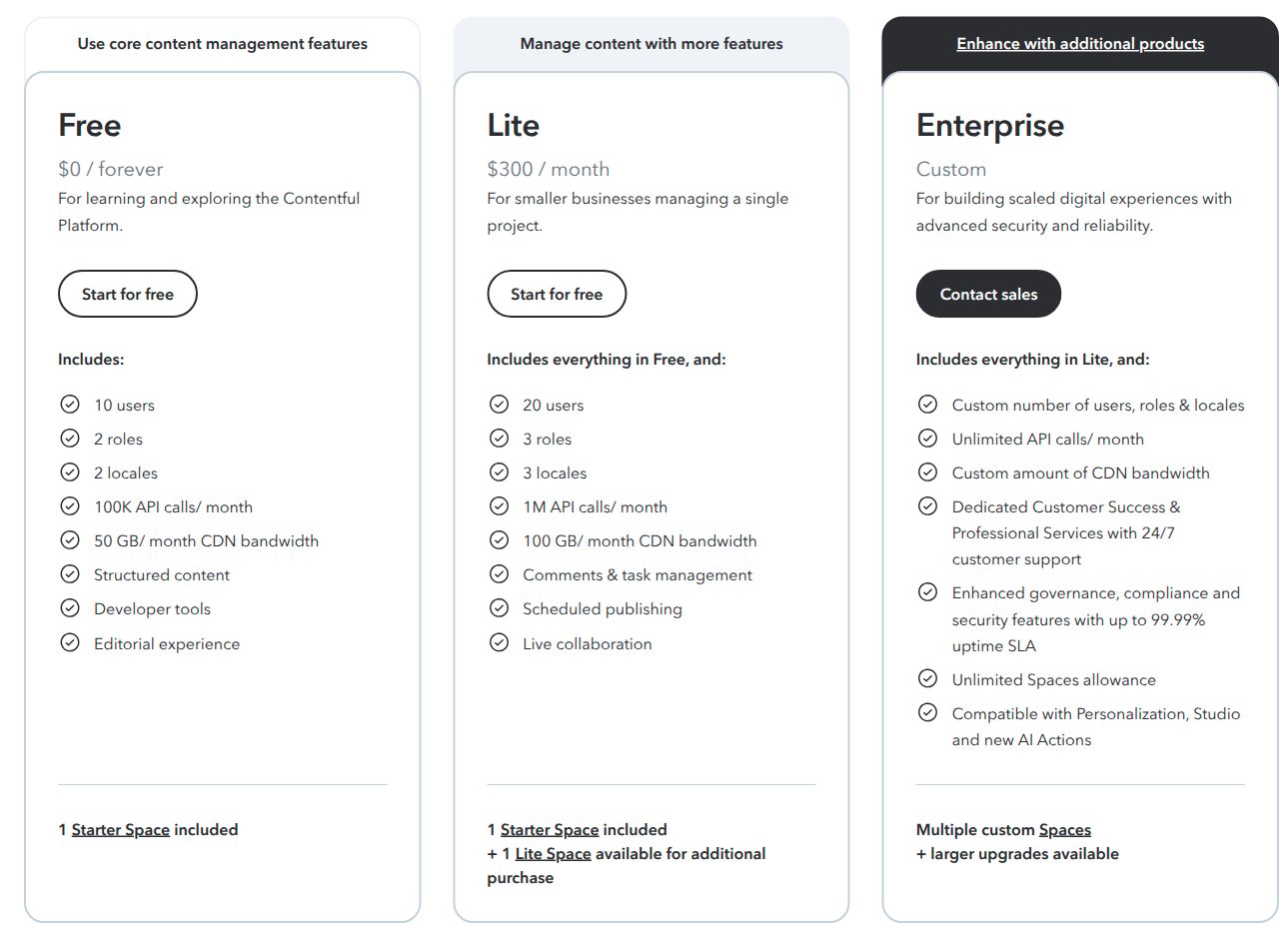
Contentful platform plan comparison from the official site, 2026-11-27. This guide models only Lite usage overages.
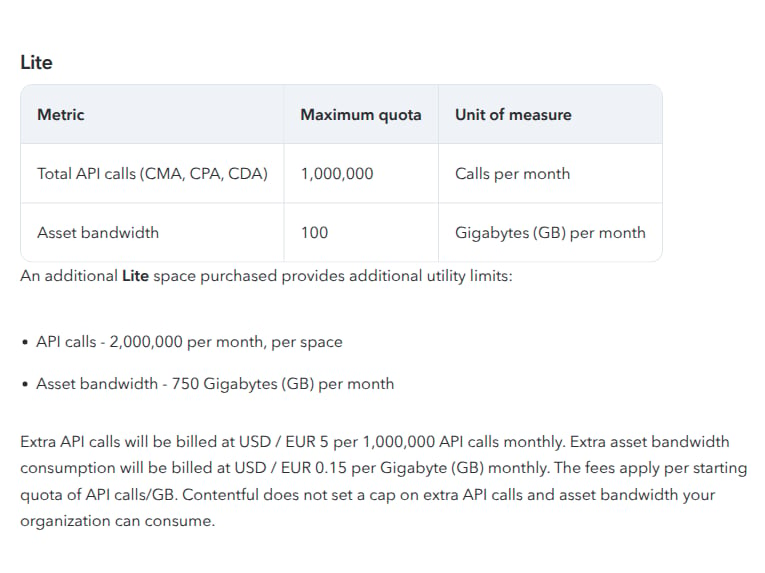
Contentful Lite overage rates from the official site, 2026-11-27. This guide models only Lite usage overages.
Pricing profile
What Contentful charges
Design takeaways
- Round at the organization boundary. Apply the allowance to the monthly organization total before rounding. Rounding per request or per project can turn several fractions of a block into several billable blocks Published terms.
- Treat the Free cap and Lite allowance differently. Free disallows paid overages. Keep the product-side limit for Free separate from the paid overage meters attached to Lite Published terms.
How Contentful’s pricing maps to Flexprice
Configure the plan and subscription
These requests are illustrative. Use your test environment and replace example IDs with the IDs returned by your setup. Create a plan withPOST /plans:
POST /prices request.
Additional API call blocks
POST /features
POST /prices
Additional bandwidth GB
POST /features
POST /prices
Subscription and usage
Create a subscription for the organization withPOST /subscriptions. Attach the two overage prices using their returned IDs. This example uses a customer with UTC billing and a December 1 start. If the start date or timezone differs, derive the event window from the subscription’s actual period boundaries.
POST /events using the customer’s external ID. Keep its ID and timestamp stable across retries. Ensure both meters reflect the summary before invoice computation. If the summary arrives after computation, use the late-usage recovery flow for the invoice’s status.
Worked bill
In December the organization uses 2,000,001 API calls and 101.2 GB of asset bandwidth.
The usage-only invoice totals $10.30 before taxes. Check both quantities and charges on the invoice for the completed month.
Verify the charges before month-end
To test the arithmetic now, use a dedicated test customer with UTC billing. Set the subscription’sstart_date to midnight UTC on the first day of the current month. Send the synthetic summary above with a fresh event ID and a current UTC timestamp within the active period. After the meters reflect the event, call Get invoice preview with the test subscription ID. It previews the current period without creating an invoice.
POST /invoices/preview
Pricing sources
- Contentful pricing: Plan price, allowances, and included space.
- Contentful usage limit policy: Started-block rates and usage scope.
- Contentful invoice documentation: Monthly invoice generation.