

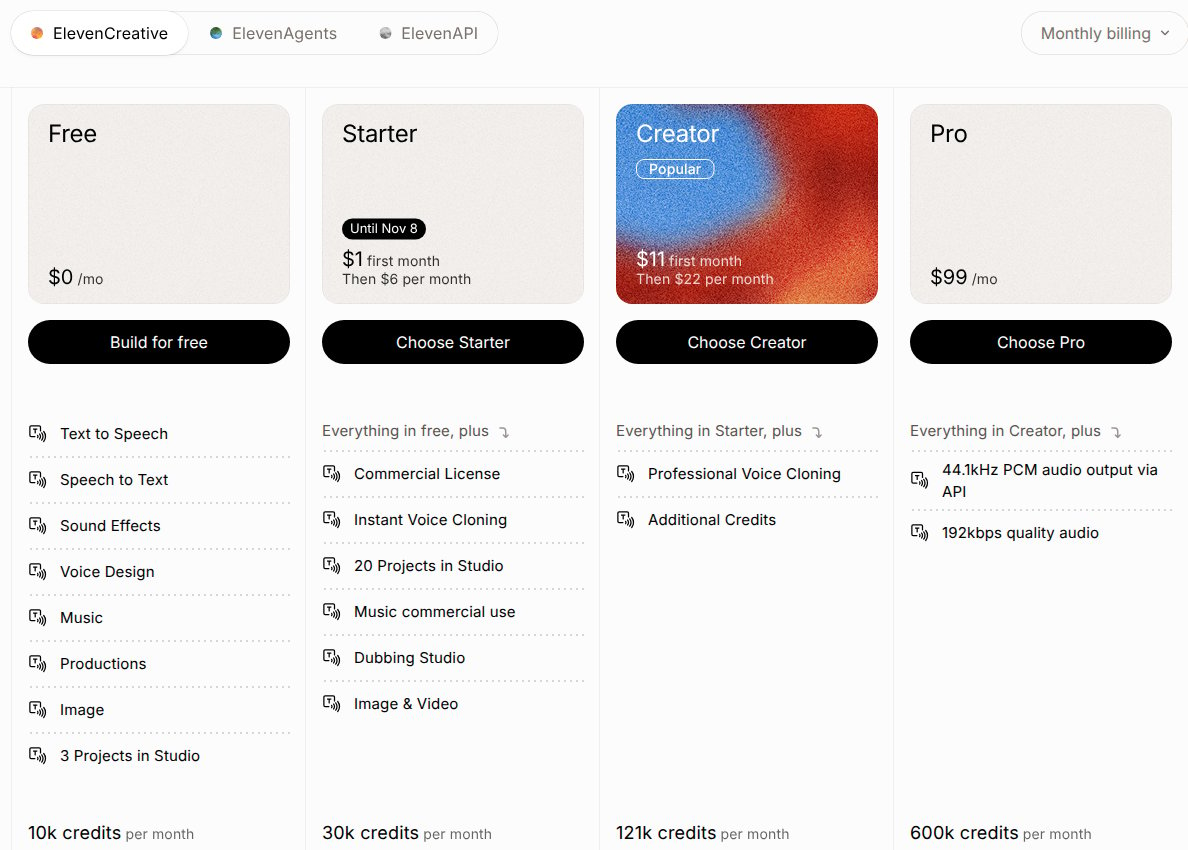
ElevenLabs monthly plan cards, captured from its official pricing page on November 4, 2026. This teardown uses Creator's ordinary $22 monthly fee and 121,000-credit allowance for Multilingual v2 TTS only; first-month discounts and other plans and products are excluded.
The example starts with no carried credits, uses ordinary voices without extra credit multipliers, and has no other products consuming the shared pool. It excludes the introductory discount, annual plans, paid top-ups, legacy overages, taxes, voice cloning entitlements, and other models. It does not implement rollover, so it is not a complete reproduction of an ongoing ElevenLabs account with unused credits.
Pricing profile
These labels describe only the self-serve monthly Creator offering modeled here, using the Multilingual v2 Text to Speech API. They do not classify ElevenLabs as a whole or include the excluded products and payment paths.Creator pricing and credit accounting
The official pricing page, with monthly billing selected, lists these terms:
The allowance is shared across products. A separate 121,000-credit entitlement for every model would multiply the customer’s included usage incorrectly. For this single-model example, 121,000 credits can fund 121,000 charged characters. The model documentation also sets a 10,000-character limit per Multilingual v2 request; that is a request limit, not a billing package size.
The pricing FAQ says credits are charged per generation request, not per download. Some unchanged regenerations can be free. Count charged usage, not downloads or every retry indiscriminately.
What happens after the allowance
For new self-serve customers, Pay As You Go extends usage with prepaid top-ups, not postpaid overage debt. Included subscription credits are consumed first. The minimum USD top-up is $5, and purchased credits expire 12 months after purchase. With no available credits and Auto Top Up off, service pauses. The billing documentation separately describes usage-based billing for eligible legacy subscriptions and Enterprise. Do not apply a legacy postpaid rate to a new Creator subscription. This guide creates neither top-ups nor an overage price. Without that extension, your application must stop generation when the included allowance is exhausted.How ElevenLabs’s pricing maps to Flexprice
These are consumption credits, not USD wallet credits. Do not create a $121,000 wallet or infer a per-character overage rate by dividing the $22 fee by the allowance. There is no minimum-spend commitment, volume tier, or rounded character package in this example.
Set up the feature and monthly plan
1
Create one credit-consumption feature
Go to Product Catalog > Features > Add Feature. Name the feature ElevenLabs Multilingual v2 credits, choose Metered, and use the following settings:
Leave reporting conversion unset and retain raw credit counts. A reporting conversion divides raw usage by
conversion_rate for display; it does not change billing arithmetic or perform the model’s character-to-credit conversion.2
Create the recurring charge
Go to Product Catalog > Plans > Add and create ElevenLabs Creator TTS Example. Add one recurring fixed charge in USD, amount 22.00, billing period Monthly, count 1, billed in advance. Do not add a per-character price, a package charge, or a second charge for included usage. This setup models an ordinary renewal, not the $11 introductory month.
3
Attach the included allowance
In the plan’s Entitlements section, add the credit-consumption feature. Set the usage limit to 121000, turn off the soft-limit option, and align the monthly reset with the subscription billing cycle, not the first day of the calendar month. The corresponding entitlement settings are
usage_limit: 121000, is_soft_limit: false, and usage_reset_period: "MONTHLY".This is a standard quantity entitlement, not a short-window entitlement grant. It does not roll unused credits forward. Do not reuse it unchanged for later cycles that begin with a carried balance.4
Subscribe a customer and enforce admission
Create a customer and subscription, with subscription quantity 1, to the example plan. Before calling the generation API, check the customer’s remaining allowance and enforce the 10,000-character request limit in your application. Reserve credit capacity atomically for concurrent requests, then reconcile against actual charged usage.Flexprice meters events asynchronously; an entitlement is not an inline proxy that blocks the ElevenLabs API. Your application must prevent requests that would exceed the remaining allowance, release reservations for uncharged requests, and avoid starting additional generation once the pool is exhausted.
Send usage and verify the bill
Selectmodel_id: "eleven_multilingual_v2" in the Text to Speech request. For charged generations in the selected scope, normalize characters to credits at 1:1 on your server. Reconcile against the provider’s charged usage rather than treating a failed request, a free regeneration, or a download as new consumption.
Send one Flexprice usage event per charged generation. This is an illustrative normalized event, not an ElevenLabs API response:
event_id and timestamp unchanged when retrying event delivery so the same generation is not counted twice. Do not emit both streaming fragments and a final total as separate charged usage.
Assume 80 charged generations of 1,500 characters each, no opening rollover, and no other consumption. Every request is below the 10,000-character limit:
Use decimal arithmetic to reproduce the calculation without floating-point rounding:
Design takeaways
These are modeling recommendations for this example, not claims about ElevenLabs’s business intent.- Separate allowance allocation from unit conversion. The pricing FAQ describes a shared credit pool and model-dependent character conversion. In this single-model Flexprice setup, sum normalized
creditsbehind the model filter and attach one allowance. Treating characters as a universal credit unit or allocating fresh quota per model would change the entitlement. - A request ceiling is not a billing increment. The model documentation limits Multilingual v2 requests to 10,000 characters, while pricing charges one credit per character for that model. Enforce the ceiling before calling the API, but meter actual charged credits; rounding a 1,500-character generation up to 10,000 would invent consumption.
- An excluded payment path must not become implicit debt. PAYG documentation consumes subscription credits before a prepaid balance. Because this example excludes that extension, pair the fixed charge with a hard quantity entitlement and application-side admission, not a postpaid usage price. Supporting top-ups later would require a separate balance lifecycle rather than merely removing the limit.
Pricing sources
Pricing checked on 2026-11-04.- ElevenLabs pricing: monthly Creator price and allowance, introductory discount, model-dependent conversion, shared credits, request charging, rollover and tax exclusions.
- ElevenLabs billing: subscription cadence and the distinction between new self-serve top-ups and legacy usage-based billing.
- ElevenLabs Pay As You Go: consumption priority, $5 USD minimum top-up, 12-month expiry and service pause without available prepaid balance.
- ElevenLabs models: Multilingual v2 model identifier and 10,000-character request limit.
- ElevenLabs Text to Speech API: selecting the model for a generation request.
- ElevenLabs API overview: AI voice infrastructure and the developer audience for the REST API and SDKs.