

command-r-08-2024.
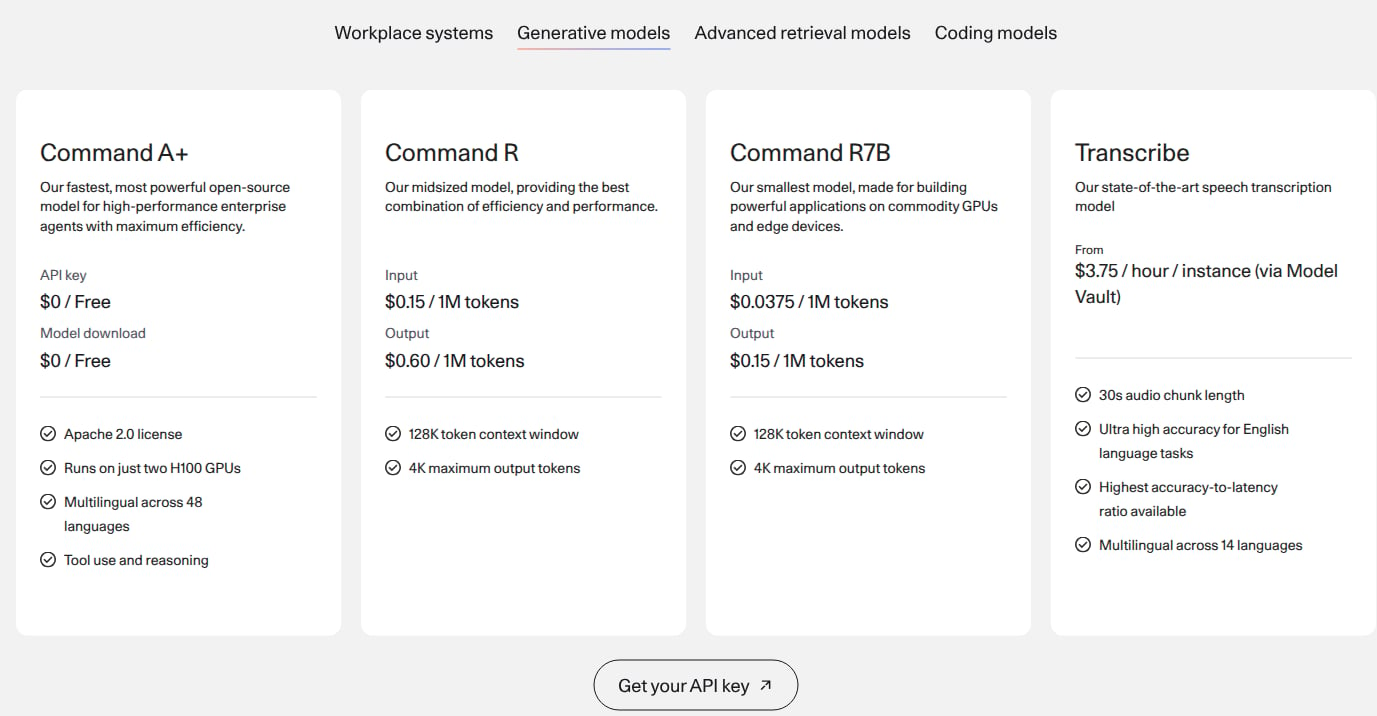
Cohere's complete Generative models comparison, captured on November 11, 2026, with all four cards, token rates, inclusions and the API-key entry point visible. Only Command R production API token charges are modeled; Command A+, Command R7B and Transcribe are shown for context.
This example covers USD token charges on Cohere’s direct API using a production key. It excludes trial-key usage, other models and endpoints, private or dedicated deployments, partner-hosted pricing, discounts and tax. The illustrative Flexprice plan bills monthly in arrears. It does not reproduce Cohere’s additional invoice trigger at $250 of outstanding balance.
Pricing profile
These labels describe the Command R production API offering, not every Cohere product or sales channel.
The pricing page offers API-key signup. Its FAQ says an organization owner requests a production key through the billing workflow. Trial access is not permission to use the free key for production or commercial workloads.
Command R token prices
The Generative models rate cards publish the following prices. The Command R documentation identifies the August 2024 API model ascommand-r-08-2024. Do not apply these rates to the older March 2024 model listed separately in the pricing FAQ.
One million tokens is the rate’s denominator, not a minimum package. Track raw integer counts of billed tokens and retain the decimal per-token prices.
Cohere’s billing guide distinguishes
billed_units from tokens. Cohere can add tokens internally that are not charged to the customer. For the v2 Chat response, use usage.billed_units.input_tokens and usage.billed_units.output_tokens, not the corresponding totals under usage.tokens.
Design takeaways
- Meter the billing measure, not the closest telemetry measure. Cohere’s billed-versus-total distinction means a generic token counter can overstate charges. Normalize the provider’s billed fields before sending usage to Flexprice.
- Keep input and output independently priced. The output rate is four times the input rate. Two SUM meters preserve the mix instead of hiding it inside a blended rate or one total-token count.
- Separate rate calculation from invoice timing. Cohere’s month-end or $250 balance trigger changes when collection occurs, not the token unit prices. A monthly plan can model the usage charges without claiming to recreate the extra invoice trigger.
How Cohere’s pricing maps to Flexprice
The event and plan names below are integration-defined examples, not Cohere API resources. Do not add a fixed subscription fee, token allowance or credit grant to this usage-only example. Do not invent a separate cache rate from another provider’s pricing model.
Set up the metered features
Create an input-token feature. Both filters must match for an event to contribute usage:Configure the usage-only plan
Create a plan without a recurring fixed charge:FLAT_FEE here means a constant usage rate, not a fixed monthly subscription charge. Do not use a package that rounds usage up to a million tokens. Add an unlimited metered entitlement for each feature, then create a customer and a subscription to this plan with quantity 1. Unlimited access does not make usage free.
Normalize and send usage
Read the completed provider response on your server. Map the fields as follows:
Do not send the API key itself. Your integration supplies the non-sensitive
key_type label; it is not a Cohere response field. Do not substitute usage.tokens if billed quantities are missing. Hold those records for reconciliation instead of silently guessing the charge.
For a completed production call with 6,772 billed input tokens and 248 billed output tokens, the normalized usage event is:
6772 × 0.00000015 + 248 × 0.0000006. They illustrate normalization, not a live request executed by this guide.
Send the final billed counts once, not both streaming deltas and the final total. Use a stable event ID and preserve the original timestamp when retrying delivery of the same usage record. Flexprice deduplication requires both to match. A new separately charged provider call is a different record. Do not send a batch together with the individual records it contains.
Worked usage calculation
Suppose one customer’s billing period contains 40 million billed input tokens and 10 million billed output tokens, all forcommand-r-08-2024 using production keys:
The same 50 million total billed tokens would cost a different amount with a different input/output mix. If all 50 million were input, the charge would be $7.50; if all were output, it would be $30.00. Keep both quantities separate through aggregation.
Retain decimal precision until invoice currency rounding. Do not round every request to cents or round token quantities up to a million. The $12.00 excludes discounts and tax. It demonstrates the usage-rate calculation, not Cohere’s full payment workflow or a guarantee about production-key approval. This guide does not execute setup or API calls.
Pricing sources
- Cohere pricing: current Generative models rates, trial/production distinction, production activation and invoice timing.
- How Cohere pricing works: separate input/output prices and billed-versus-total tokens.
- Cohere v2 Chat API: model selection and response usage structure.
- Command R: the
command-r-08-2024model identifier and offering scope.