

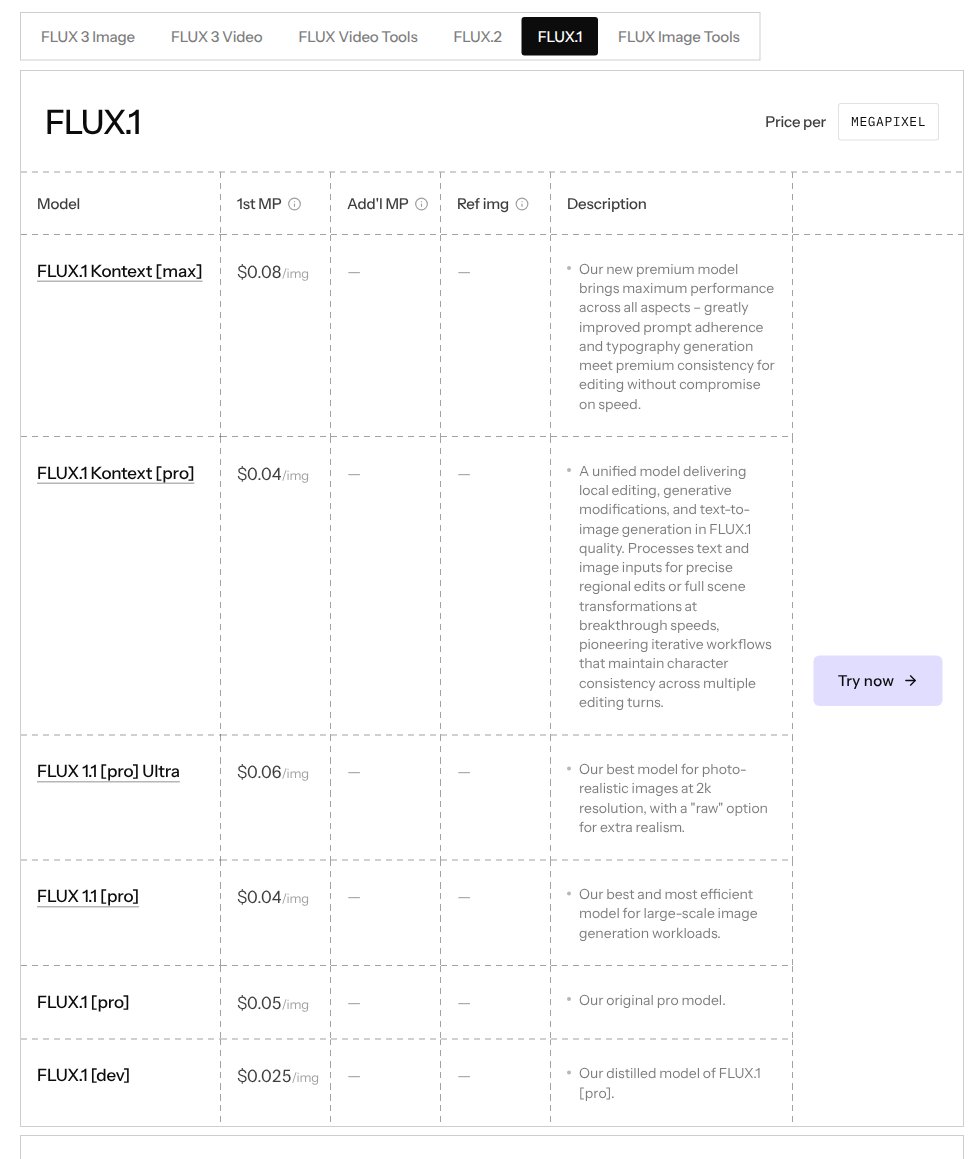
Black Forest Labs' complete FLUX.1 model-price comparison, captured on November 16, 2026. The selected model-family tab, all six model rows, prices, units, descriptions and table bottom are visible. Only standard FLUX1.1 [pro] is modeled; Kontext, Ultra and the other models are comparison context.
This example uses USD and covers standard FLUX1.1 [pro] through the direct API, not FLUX1.1 Ultra or Raw, Kontext, FLUX.2, FLUX 3, editing tools, third-party hosting, open-weights licensing or enterprise contracts. It excludes credit purchases, auto top-up, transfers, refunds, expiry, promotional balances, discounts and taxes. Monthly arrears is an illustrative Flexprice aggregation and invoice choice, not Black Forest Labs’ prepaid collection workflow. No live setup was executed.
Pricing profile
These labels describe the selected self-serve API charge, not every purchasing path or product.FLUX1.1 [pro] pricing
The pricing documentation explicitly labels the amount per image. Use that model-specific unit, not the pricing site’s generic megapixel column headings, and do not apply the resolution pricing of other model families to this example. There is no fixed subscription fee, included-image allowance or volume tier configured here.
The generation guide describes asynchronous submission and polling. A
Ready result makes the image available, but the status reference also includes pending, moderation and error states. It does not establish a complete charging or refund policy for every state. Reconcile billability upstream rather than treating every HTTP request, retry or status poll as a new image charge.
Design takeaways
- Price the output, not the transport. One generation can require several status polls. The published unit is an image, so a SUM of finalized image counts preserves the rate while counting API calls would inflate it. The premise comes from the per-image table and asynchronous generation flow.
- Keep the model identity in the billing key. Standard and Ultra have separate rows and rates in the model comparison. An endpoint filter prevents a broader image-event stream from silently applying the standard rate to another model. Price resolution-sensitive families separately rather than introducing an unsupported multiplier here.
- Separate consumption value from funding. Credits are shared at the organization level, while project usage remains attributable. A $50 consumption total is not necessarily a $50 credit purchase in that month. The credit-management workflow requires a separate balance and funding layer if the goal is to reproduce prepaid collection.
How Black Forest Labs’ pricing maps to Flexprice
FLAT_FEE means a constant rate for each image when paired with type: "USAGE". It does not add a monthly subscription fee. There is no package rounding, reporting-unit conversion or included tier.
Create the image feature
The following request bodies are illustrative. Use your Flexprice environment’s API base URL and authentication, and replace example IDs with returned IDs. Create the feature withPOST /features:
billing_scope is an application-defined routing label, not a provider response field.
Configure the usage-only plan
Create a plan withPOST /plans:
POST /prices, substituting the returned plan and meter IDs:
Send normalized image usage
Your server must normalize provider activity into finalized billable image quantities. Thebillable_images property below is your integration’s field, not a field promised by the provider API.
Send one incremental event per finalized generation with
POST /events:
event_id and timestamp on every delivery retry. Do not replace the original usage time with the retry’s send time: this SUM meter depends on both fields matching for deduplication. Do not emit another image event for each poll, redownload, replayed callback or cumulative dashboard snapshot. Hold unresolved billability for reconciliation; failure adjustments and refunds need a separate verified workflow and are outside this example.
Worked monthly charge
Assume one organization has 1,250 finalized billable images from standard FLUX1.1 [pro] in the illustrative monthly period, across any number of its projects:
Credit cross-check:
1,250 × 4 = 5,000 credits, and 5,000 × $0.01 = $50.00. These are two representations of the same consumption, not additive charges. The organization’s credit purchases and remaining balance are separate from this total.
Boundary checks:
- 0 images: $0.00. No minimum or fixed charge is introduced.
- 1 image: $0.04, not a minimum pack or a megapixel charge.
- 25 images: $1.00, equivalent to 100 credits.
- 1,251 images: $50.04. Each additional image adds $0.04.
- 750 + 500 images from two projects: still $50.00 for the same organization.
- An event for
flux-pro-1.1-ultradoes not match this meter; price it separately if added later.
Pricing sources
Pricing checked on 2026-11-16.- Black Forest Labs pricing: selected FLUX.1 comparison, standard rate and other model context.
- Pricing overview: 4 credits and $0.04 per standard FLUX1.1 [pro] image; $0.01 per credit.
- FLUX1.1 [pro] generation: endpoint, submission and polling flow.
- Quick start: self-serve account creation, credits and API keys.
- Credits and billing: shared organization pool, project attribution and optional auto top-up.
- Error and result statuses: pending, ready, moderation and error states; not a full billability policy.