

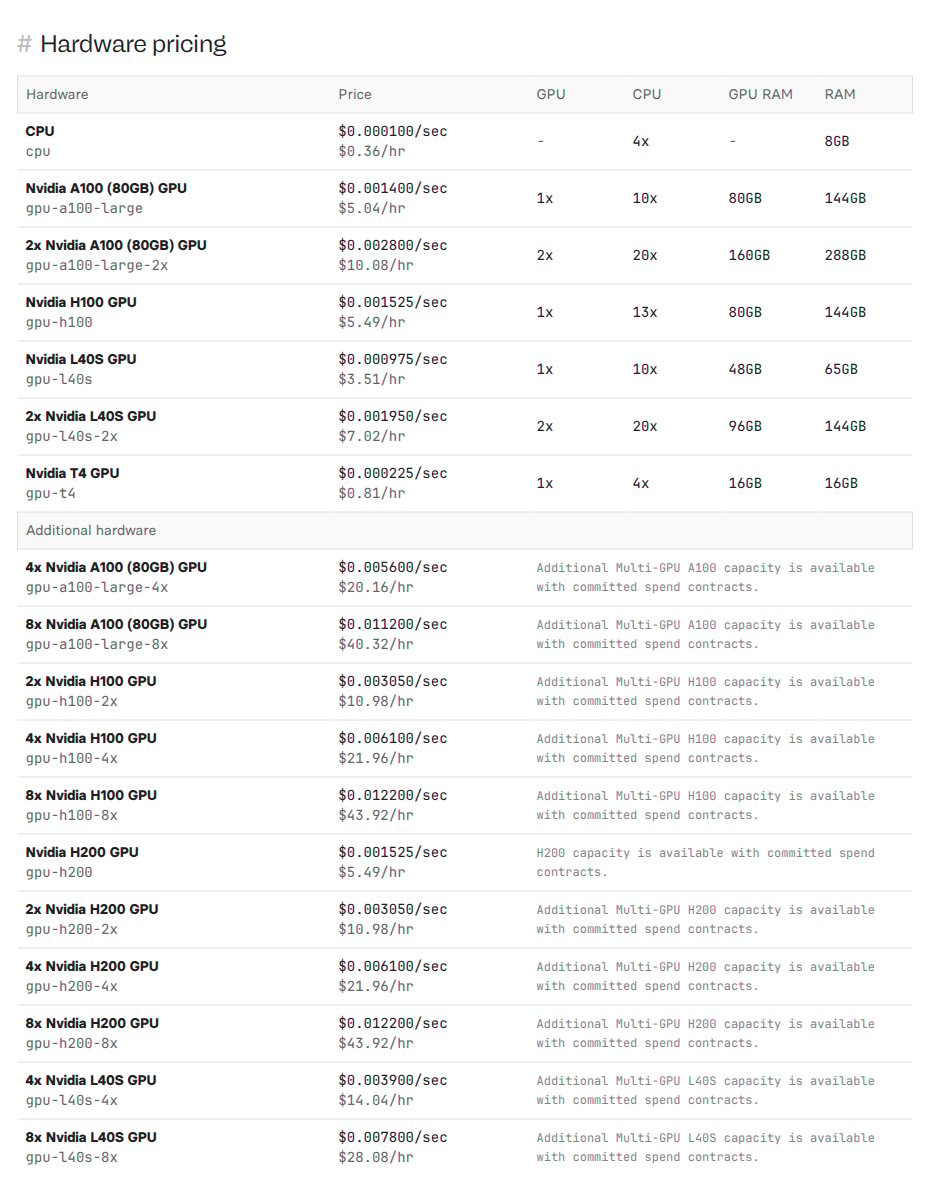
Replicate's complete hardware pricing table, including hardware offered on committed-spend contracts. Only the CPU row for time-priced public predictions is modeled. Captured November 18, 2026. Source: Replicate's official pricing page, linked below.
Pricing profile
What Replicate charges
Design takeaways
- Choose the interval that drives the charge. Client-observed elapsed time can include nonbillable work. Carry provider-equivalent active seconds, not request latency, to the meter. See the published terms.
- Filter the pricing class separately from the hardware. A public prediction is not automatically billed by runtime. Keep output-priced predictions out of the CPU seconds meter even when the event stream covers all predictions. See the published terms.
- Keep prepaid funding out of the usage formula. Replicate describes credit balances for prepaid accounts. The Flexprice example calculates gross usage before applying any funding or payment collection. See the published terms.
How Replicate’s pricing maps to Flexprice
Configure the metered subscription
These examples are illustrative. Replace example IDs with IDs returned by your Flexprice environment. Create a metered feature withPOST /features:
POST /plans:
POST /prices. Use the returned meter ID, not the feature ID. The USD price bills at the end of each period:
POST /subscriptions:
Send finalized usage
Setexternal_customer_id to the external ID of the same customer used on the subscription. The event uses integration-defined properties, not a provider response:
Worked bill
133,750 active CPU seconds × $0.000100 = $13.375 before currency rounding. An individual prediction with 12.375 rated seconds contributes $0.0012375 to that total before currency rounding. Do not round individual predictions to cents.Pricing sources
- Replicate pricing: Complete hardware rate table and public-model pricing exceptions.
- Replicate billing documentation: Active versus setup/idle time, differences for deployments and billing collection.