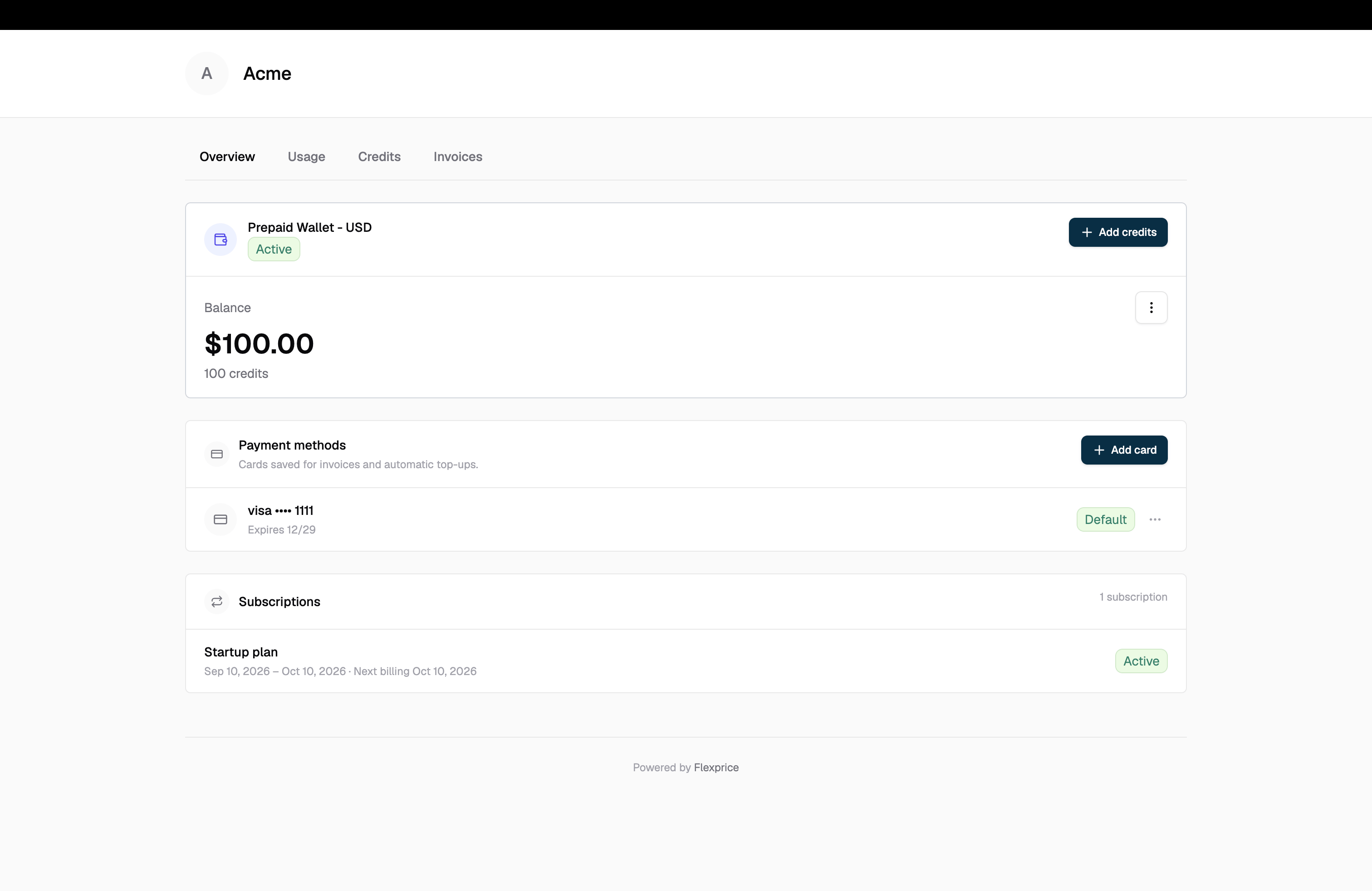
The Customer Portal is a self-service interface that gives your customers secure access to their billing information, account details, and usage analytics. Instead of contacting support for every billing question, customers can independently view their subscriptions, invoices, wallet balances, and usage data.

What is the Customer Portal?

The Customer Portal empowers your customers to manage their account information independently. Through a secure, branded interface, customers can:
  • View account overview - See wallet balances, active subscriptions, and usage at a glance
  • Track credits and transactions - Monitor prepaid wallet balances and transaction history
  • Access invoices - View, search, and download invoices with payment status
  • Analyze usage - Understand feature-level usage patterns and associated costs
This self-service approach reduces support burden while giving customers transparency and control over their billing information.
Secure AccessThe portal uses secure session tokens that expire after 1 hour, ensuring customer data remains protected while providing convenient access.

Portal Overview

The Customer Portal is organized into four main sections, each accessible via tabs at the top of the interface:
  1. Overview - Get a quick snapshot of your account: wallet balance, active subscriptions, and usage trends
  2. Credits - View detailed prepaid wallet information and complete transaction history
  3. Invoices - Browse, search, and download all invoices with payment status
  4. Usage - Analyze feature-level usage patterns and associated costs over time
Each section provides read-only access to your billing and account information, giving you full visibility into your account status without needing to contact support.

Generating a Portal Session

To give a customer access to their portal, you need to generate a secure session token. This token authenticates the customer and provides temporary access to their portal. When to generate a session:
  • When a customer requests access to their billing information
  • After customer onboarding to provide self-service access
  • When redirecting customers from your application to the portal
  • When a previous session token has expired
Endpoint: GET /v1/customers/portal/{external_id} Authentication: Requires your Flexprice API key Headers:
x-api-key: <your_api_key>
Path Parameters:
ParameterTypeRequiredDescription
external_idstringYesCustomer’s external ID

Example Request

curl --request GET \
  --url https://api.cloud.flexprice.io/v1/customers/portal/cust_123 \
  --header 'x-api-key: <your_api_key>'

Response

{
  "token": "eyJhbGciOiJIUzI1NiIsInR5cCI6IkpXVCJ9...",
  "url": "https://portal.yourapp.com?token=eyJhbGciOiJIUzI1NiIsInR5cCI6IkpXVCJ9...",
  "expires_at": "2025-01-06T17:27:17Z"
}
Response Fields:
FieldTypeDescription
tokenstringJWT token for authenticating customer portal requests
urlstringPre-built URL with the token (optional, for convenience)
expires_atstringISO 8601 timestamp when the token expires
Session Tokens ExpirePortal session tokens typically expire after 1 hour. You’ll need to create a new session when the token expires.
Redirecting customers to the portal: Once you receive the session response, redirect your customer to the url field in the response. This pre-built URL includes the token and will automatically authenticate the customer when they access it.
// Example: Redirecting customer to portal
const session = await response.json();
window.location.href = session.url; // Redirects customer to portal

Accessing the Portal from the UI Dashboard

You can also access the customer portal directly from the Flexprice dashboard without making API calls. There are two ways to open a customer’s portal from the UI:

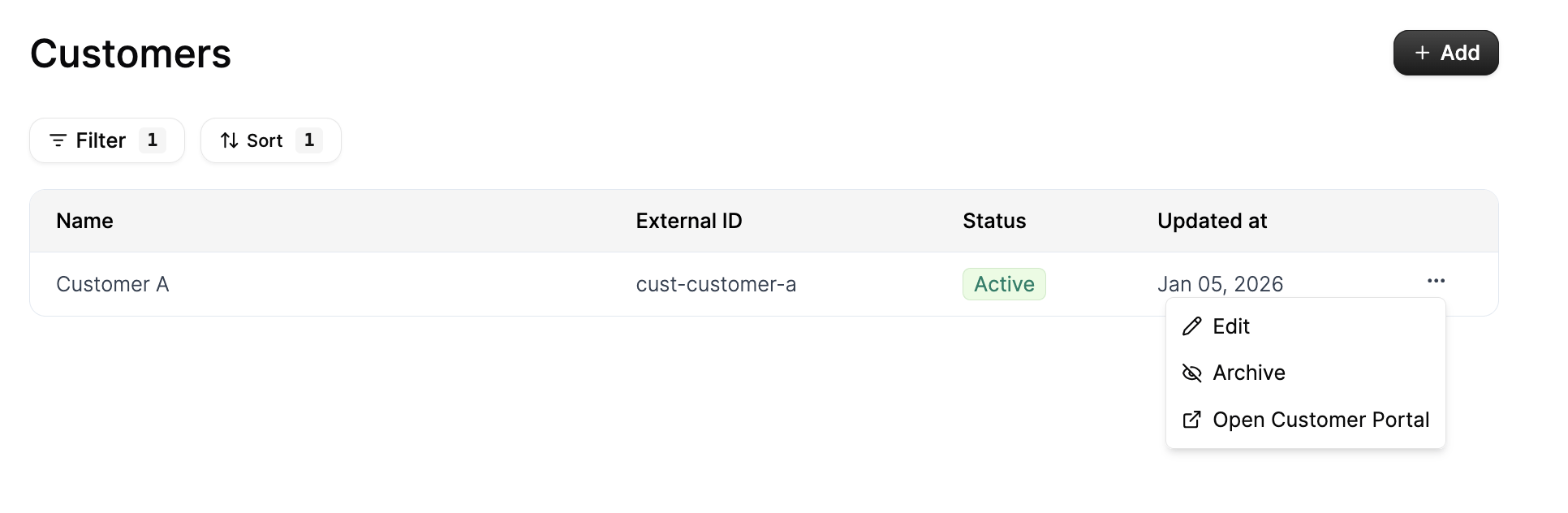
From the Customers Page

  1. Navigate to the Customers page in your dashboard
  2. Find the customer in the table
  3. Click the three-dot menu (⋮) at the end of the customer’s row
  4. Select “Open Customer Portal” from the dropdown menu
This will automatically generate a portal session and open the customer’s portal in a new tab or window.
Customers Page with Portal Option

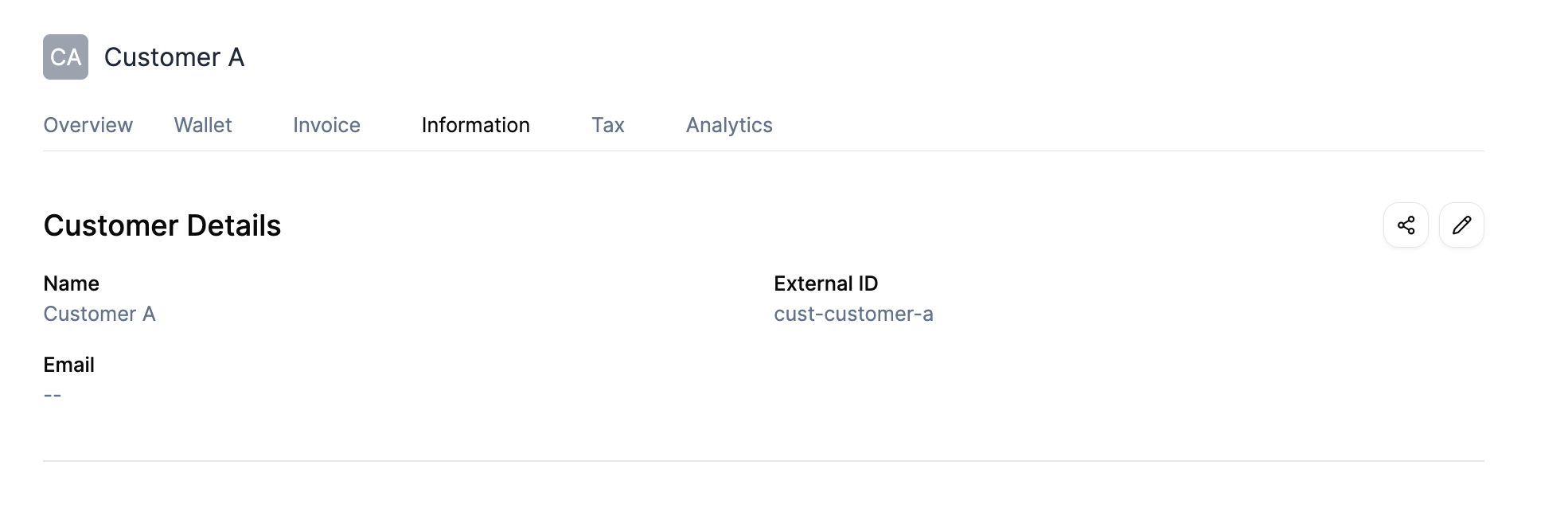
From the Customer Details Page

  1. Navigate to the Customers page
  2. Click on a customer to open their details page
  3. Go to the “Information” tab (or any tab in the customer details view)
  4. In the Customer Details section, you’ll find options to:
    • Copy the portal link - Click the share icon to copy the portal URL to your clipboard
    • Open the portal directly - The portal link can be shared with the customer or opened directly
Customer Details Page
Benefits of UI access:
  • Quick access - No need to write code or make API calls
  • One-click opening - Instantly generate and open portal sessions
  • Easy sharing - Copy portal links to share with customers via email or other channels
  • Automatic session management - The UI handles token generation and expiration automatically
Sharing Portal LinksWhen you copy the portal link from the customer details page, you can share it directly with your customer via email, chat, or any other communication channel. The link includes an embedded session token that expires after 1 hour for security.

Using the Portal Token

Once you have the session token, you can redirect your customer to the portal URL provided in the response. The portal handles authentication automatically using the token embedded in the URL.

Redirecting Customers

The simplest approach is to use the url field from the session response, which includes the token as a query parameter:
// Example: Redirecting customer to portal
const response = await fetch(
  `https://api.cloud.flexprice.io/v1/customers/portal/${customerExternalId}`,
  {
    method: "GET",
    headers: {
      "x-api-key": process.env.FLEXPRICE_API_KEY,
    },
  }
);

const session = await response.json();
// Redirect customer to portal
window.location.href = session.url;

Embedding the Portal

You can also embed the portal in an iframe within your application:
<iframe
  src="https://portal.yourapp.com?token=<session_token>"
  width="100%"
  height="800px"
  frameborder="0"
>
</iframe>

Handling Token Expiration

Since portal tokens expire after 1 hour, you should:
  1. Generate tokens on-demand - Create a new session when the customer requests portal access
  2. Handle expiration gracefully - If a customer’s session expires, generate a new token and redirect them again
  3. Monitor token lifetime - Use the expires_at field to track when tokens will expire
// Example: Checking token expiration
const session = await response.json();
const expiresAt = new Date(session.expires_at);
const now = new Date();

if (expiresAt > now) {
  // Token is still valid, redirect to portal
  window.location.href = session.url;
} else {
  // Token expired, generate a new one
  // ... generate new session
}

Direct API Access

If you’re building a custom portal interface, you can use the session token directly in API requests. Include the token in the X-Session-Token header:
X-Session-Token: <session_token>
The customer portal provides read-only access to:
  • Customer profile information
  • Active and past subscriptions
  • Invoices and payment history
  • Wallet balances and transactions
  • Usage analytics and cost data

Overview Tab

The Overview tab provides a comprehensive snapshot of your account at a glance. This is the default view when customers first access the portal.
Customer Portal Overview

Prepaid Wallet

The Prepaid Wallet section displays your current credit balance in two formats:
  • Credits - The raw credit amount (e.g., “434.2 credits”)
  • Dollar Value - The monetary equivalent of your credits (e.g., “$43.42 value”)
This dual display helps you understand both your credit balance and its real-world value. Credits are typically used for metered billing, where usage is deducted from your prepaid balance.

Subscriptions

The Subscriptions section shows your active subscription plan:
  • Plan Name - The name of your current subscription plan (e.g., “Plan Base”)
  • Status - Current subscription status, typically “Active” for active subscriptions
  • Subscription Period - The current billing period with start and end dates (e.g., “Jan 6, 2026 - Feb 6, 2026”)
  • Next Billing - The date when your next billing cycle begins
This information helps you track your subscription status and know when your next billing will occur.

Usage Graph

The Usage section includes an interactive graph showing your usage trends over time:
  • Time Range Selector - Choose between 1 day (1d), 7 days (7d), or 30 days (30d) views
  • Usage Visualization - A line graph showing usage patterns over the selected time period
  • Y-Axis - Represents usage quantity (e.g., 0 to 6,000 units)
  • X-Axis - Represents time (dates)
The graph helps you identify usage patterns, spikes, and trends. Use the time range selector to zoom in on recent activity or get a broader view of your usage over the past month.

Credits Tab

The Credits tab provides detailed information about your prepaid wallet, including balance details and complete transaction history.
Customer Portal Credits

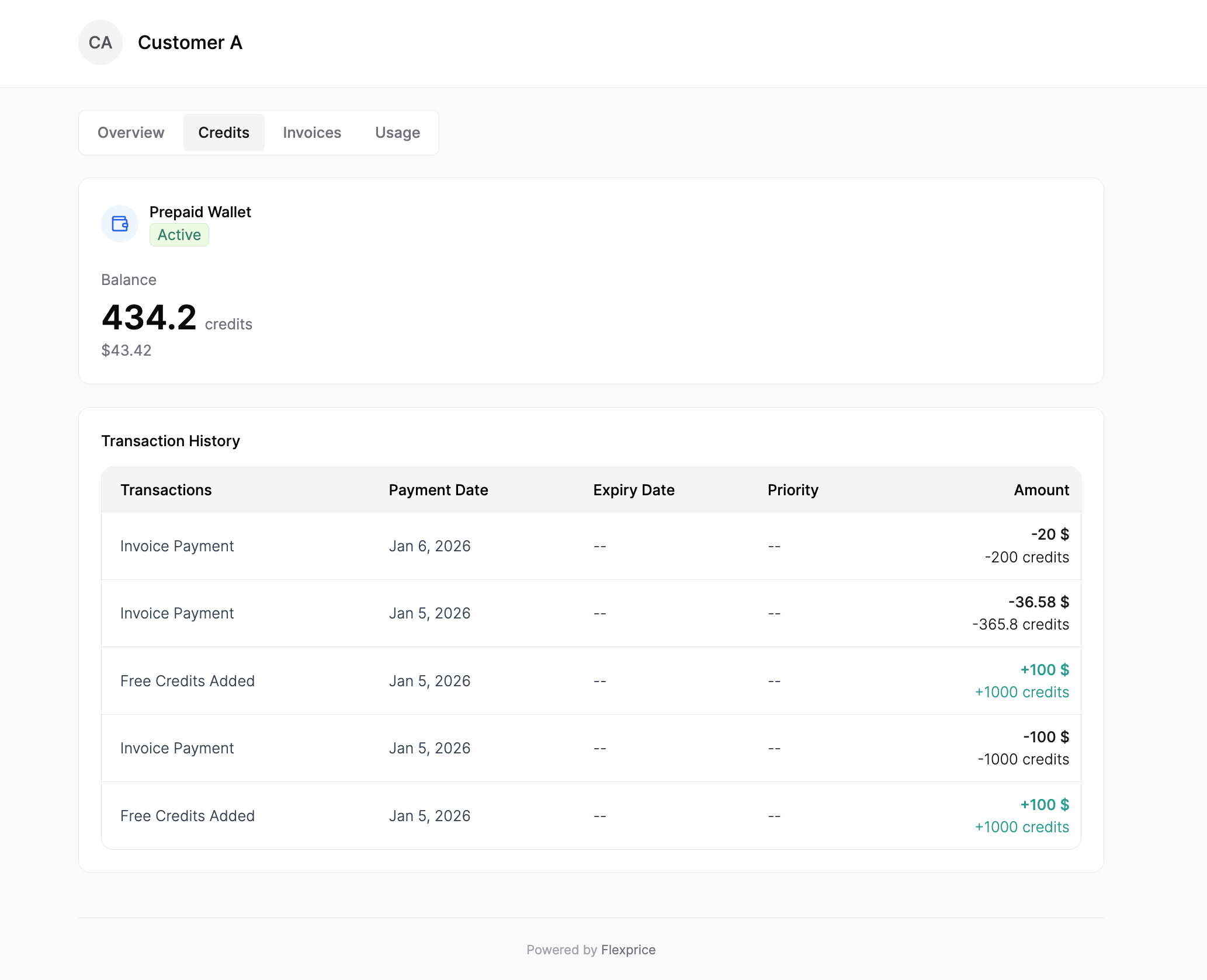
Prepaid Wallet Details

At the top of the Credits tab, you’ll see your Prepaid Wallet summary:
  • Balance - Your current credit balance displayed prominently
  • Status - Wallet status indicator (typically “Active” for active wallets)
  • Dollar Value - The monetary equivalent of your credits
This gives you a quick reference for your available balance before diving into transaction details.

Transaction History

The Transaction History table provides a complete record of all credit-related transactions:
ColumnDescription
TransactionsType of transaction (e.g., “Invoice Payment”, “Free Credits Added”)
Payment DateWhen the transaction occurred
Expiry DateWhen credits expire (if applicable)
PriorityTransaction priority level
AmountTransaction amount in both dollars and credits
Transaction Types:
  • Invoice Payment - Credits deducted when paying invoices (shown as negative amounts, e.g., “-20 $ / -200 credits”)
  • Free Credits Added - Credits added to your account (shown as positive amounts, e.g., “+100 $ / +1000 credits”)
The dual currency display (dollars and credits) helps you understand both the monetary impact and credit balance changes. Negative amounts indicate deductions, while positive amounts indicate additions to your wallet.

Invoices Tab

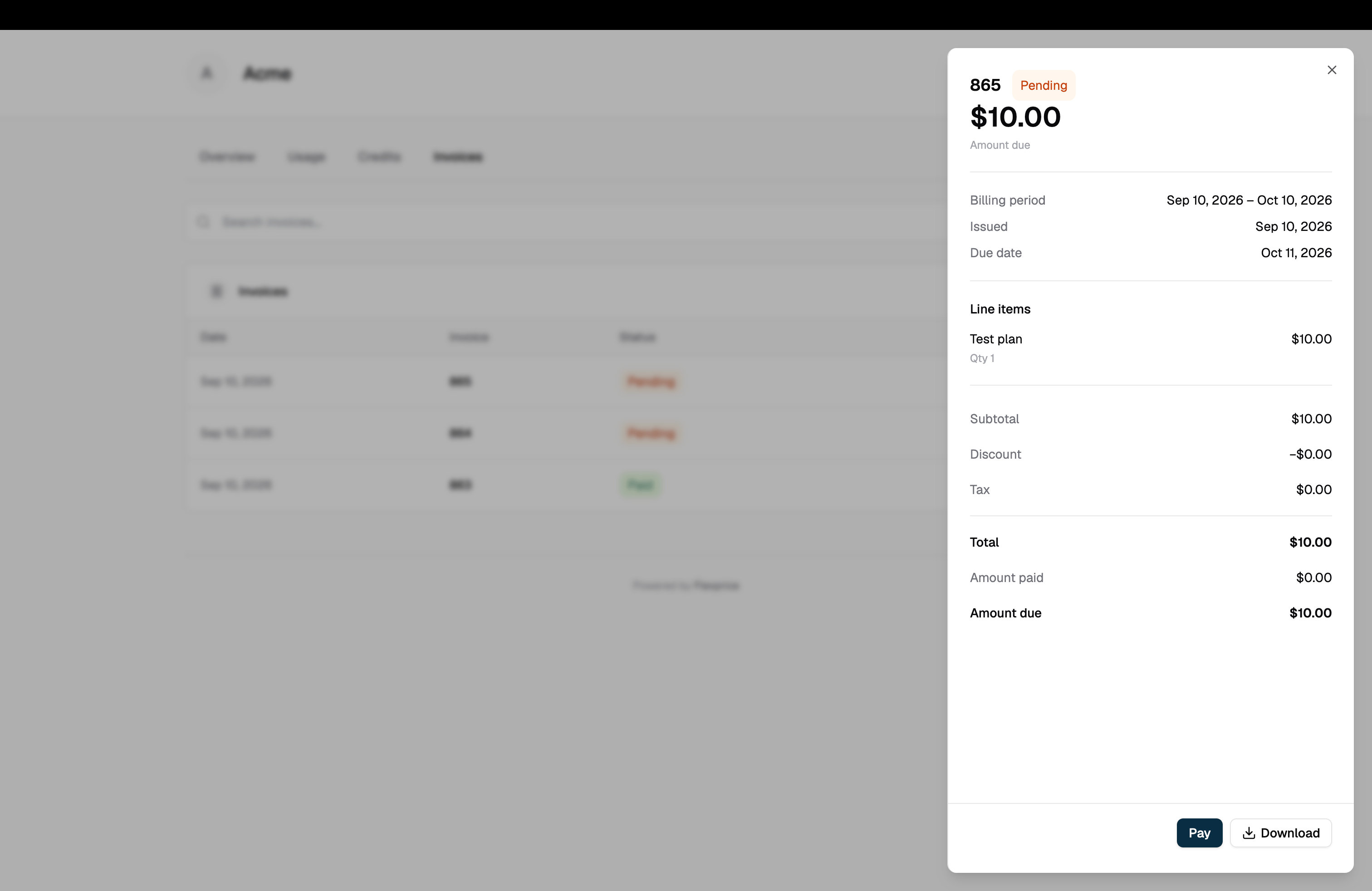
The Invoices tab allows you to view, search, and download all your invoices with their payment status.
Customer Portal Invoices

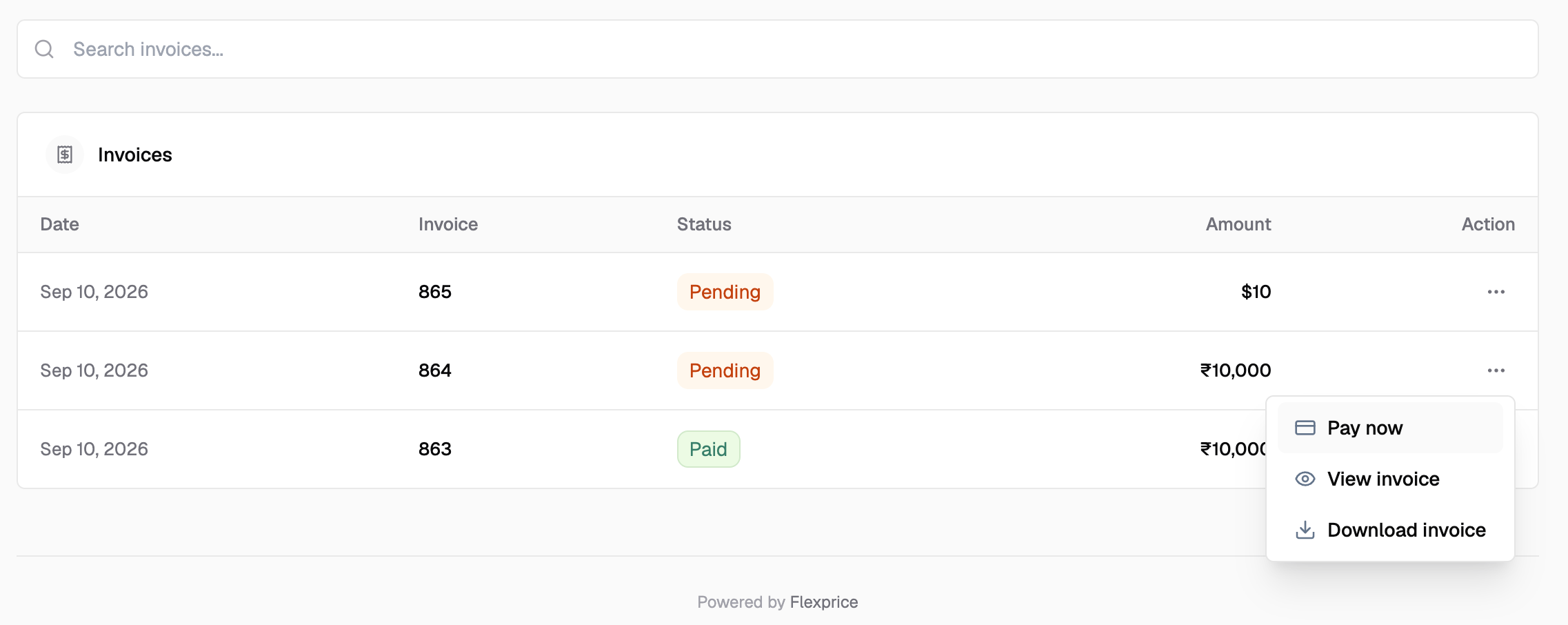
Invoice Table

The invoice table displays all your invoices with the following information:
ColumnDescription
DATEThe date the invoice was issued
INVOICE #Unique invoice identification number (e.g., “INV-202601-00003”)
STATUSPayment status of the invoice
AMOUNTTotal invoice amount
DOWNLOADIcon to download the invoice PDF

Invoice Status

Invoices display their payment status with color-coded indicators:
  • Paid (Green) - Invoice has been successfully paid
  • Pending (Orange) - Invoice is awaiting payment
This visual status helps you quickly identify which invoices need attention and which are complete.

Search Functionality

Use the search bar at the top to quickly find specific invoices. You can search by:
  • Invoice number
  • Date range
  • Amount
  • Status
Simply type your search term in the “Search invoices…” field to filter the invoice list.

Downloading Invoices

Click the download icon in the DOWNLOAD column to save a PDF copy of any invoice. This is useful for:
  • Record keeping
  • Accounting purposes
  • Dispute resolution
  • Tax documentation

Usage Tab

The Usage tab provides detailed analytics about your feature-level usage and associated costs.
Customer Portal Usage

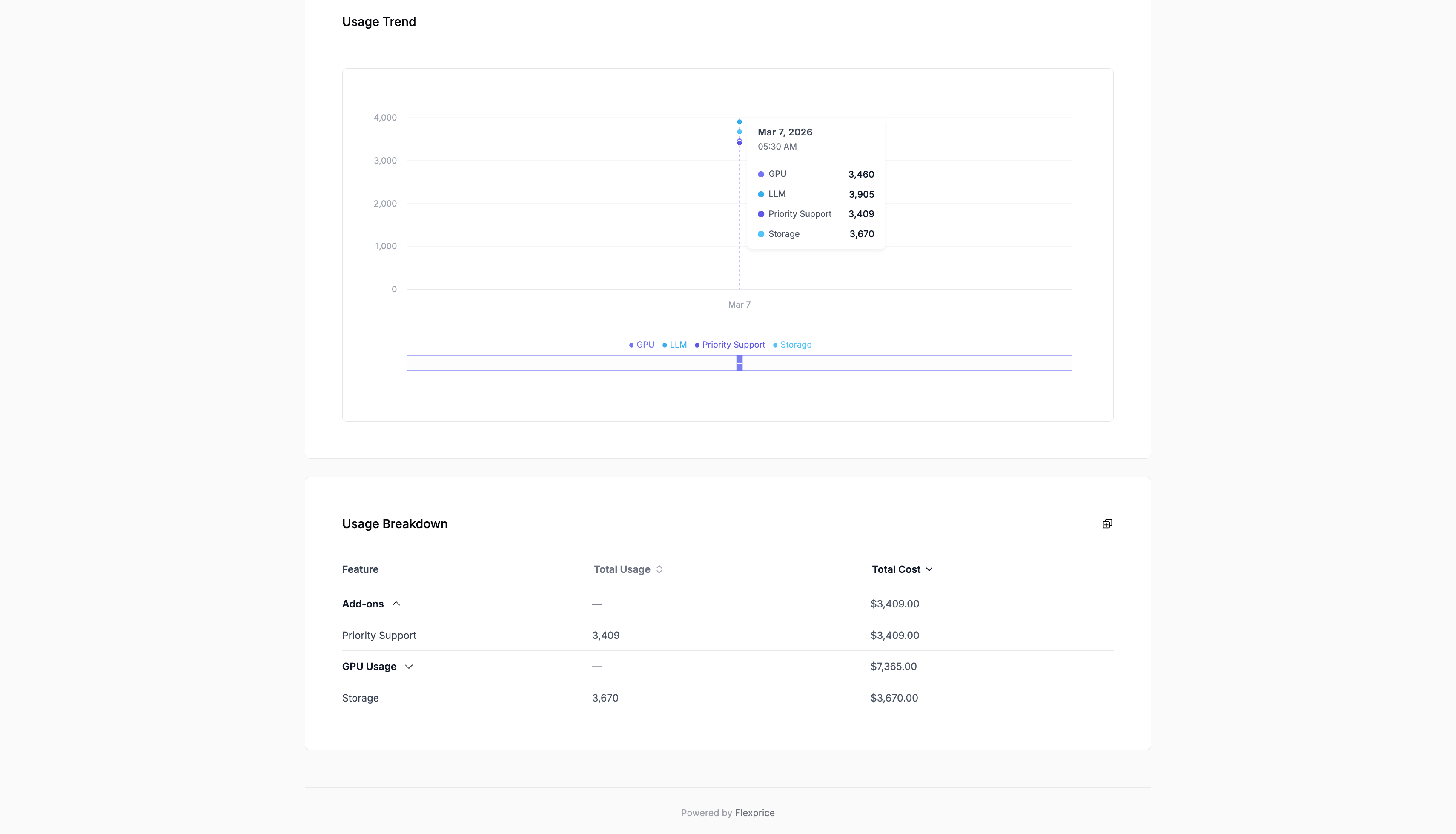
Usage Graph

The interactive usage graph visualizes your usage patterns over time:
  • Time Range Selector - Choose between 1 day (1d), 7 days (7d), or 30 days (30d) views
  • Feature-Level Tracking - Each feature is represented by a different color on the graph
  • Interactive Tooltips - Hover over data points to see detailed information:
    • Exact date and time
    • Feature name
    • Usage quantity at that point
The graph helps you:
  • Identify usage spikes and patterns
  • Compare usage across different time periods
  • Understand when peak usage occurs
  • Track usage trends over time

Usage Breakdown Table

Below the graph, the Usage Breakdown table provides feature-level usage statistics:
ColumnDescription
FeatureThe name of the feature being tracked (e.g., “Feature B”)
Total UsageTotal usage quantity with unit (e.g., “5,911 calls”)
EventsNumber of usage events recorded
Total CostTotal cost associated with this feature’s usage (e.g., “$141.86”)
This breakdown helps you:
  • Understand which features consume the most resources
  • Calculate cost per feature
  • Identify optimization opportunities
  • Track usage efficiency
Interpreting the Data:
  • Total Usage shows the cumulative usage quantity for the selected time period
  • Events indicates how many individual usage events contributed to the total
  • Total Cost represents the billing amount for this feature’s usage, helping you understand the financial impact

Understanding Your Data

This section helps you interpret the information displayed throughout the portal.

Wallet Balances

Your prepaid wallet balance represents credits available for billing. When you use services, credits are deducted from this balance. The dollar value shows the monetary equivalent, helping you understand the real-world value of your credits. Key points:
  • Credits are deducted when invoices are paid or services are used
  • Free credits and top-ups increase your balance
  • Monitor your balance to ensure sufficient credits for continued service

Subscription Status

Your subscription status indicates the current state of your plan:
  • Active - Your subscription is active and billing will continue as scheduled
  • The subscription period shows your current billing cycle
  • Next billing date indicates when your next charge will occur

Usage Graphs

Usage graphs help you visualize consumption patterns:
  • Spikes indicate periods of high usage
  • Trends show whether usage is increasing, decreasing, or stable
  • Time range selection lets you zoom in on recent activity or view longer-term patterns
  • Feature colors help distinguish between different features on the same graph

Cost Tracking

Understanding costs helps you manage your budget:
  • Total Cost in the Usage Breakdown shows billing for each feature
  • Invoice amounts show what you’ve been charged
  • Transaction history shows credit deductions and additions
  • Compare usage to costs to understand your cost per unit of usage

Portal Features

The Customer Portal provides self-service access to your billing information, but it has specific capabilities and limitations.

What You Can Do

  • View account information - See your customer profile, subscriptions, and account details
  • Monitor wallet balances - Track prepaid credits and transaction history
  • Access invoices - View, search, and download all invoices
  • Analyze usage - Review feature-level usage patterns and costs
  • Track subscriptions - Monitor active subscriptions and billing cycles

Limitations

The portal provides read-only access. You cannot:
  • Modify subscription plans
  • Update payment methods
  • Change billing information
  • Cancel subscriptions
  • Make payments
These actions require contacting your account administrator or support team.

When to Contact Support

Contact support when you need to:
  • Change your subscription plan
  • Update payment methods or billing information
  • Cancel or pause your subscription
  • Resolve billing disputes
  • Request refunds or credits
  • Get help interpreting your usage data
  • Report technical issues with the portal