

Overview
Consolidated billing lets an enterprise or holding company purchase one plan that covers multiple subsidiary teams or entities. Each child customer generates usage independently, but all usage aggregates under the parent subscription, producing a single invoice for the parent.subscription_type results:
- Parent subscription:
parent - Each child:
inherited(auto-created skeleton, no line items)
How it works
When to use consolidated billing
- Enterprise with subsidiaries: Global HQ purchases an enterprise plan. Regional divisions (APAC, EMEA, Americas) each generate usage independently. HQ receives one consolidated invoice.
- Holding company: A holding company owns multiple brands. Each brand operates as a customer. Finance at HQ handles all invoices.
- Internal chargeback: A company tracks usage per department for internal reporting, but the central IT team is invoiced.
Prerequisites
- Parent customer created in Flexprice
- Each child customer created in Flexprice (with a known
external_id) - A plan created in the product catalogue
- Child customers must not already have an active
inheritedsubscription under another parent
On create, you cannot combine
inheritance.external_customer_ids_to_inherit_subscription with
invoicing_customer_external_id or subscriptions_ids_for_grouped_invoicing
in the same request.Configure
Step 1: Create customers
Create the parent customer and each child customer through the Dashboard or API. Customer records have no hierarchy fields; they stay flat.Step 2: Create the parent subscription with child inheritance
- Dashboard
- API
- Navigate to Subscriptions and click Create Subscription
- Select the parent customer and choose a plan
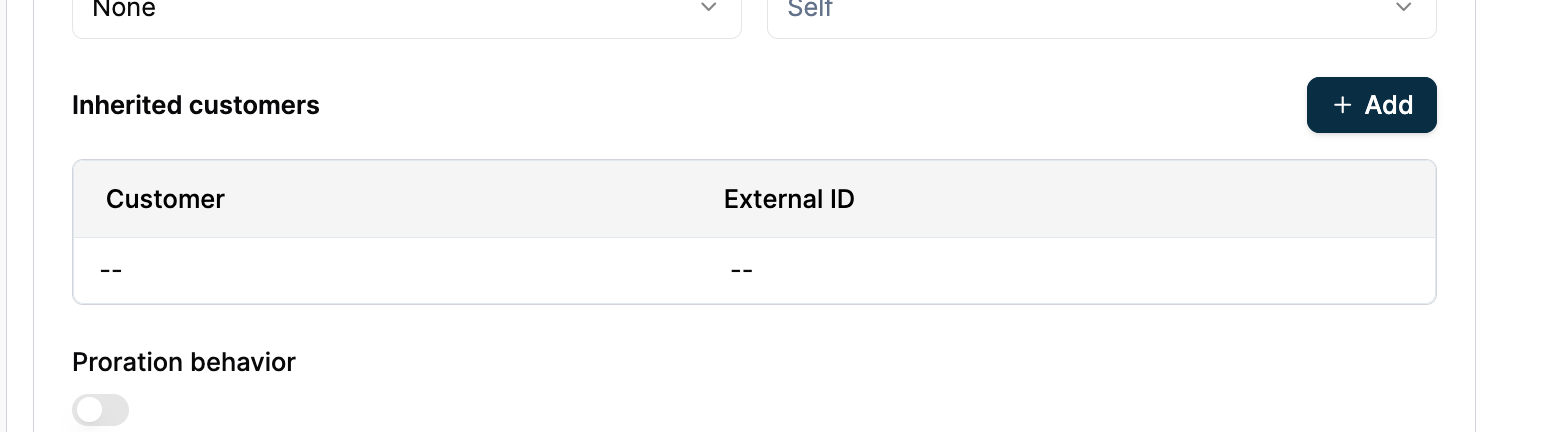
- In the Customer Hierarchy section, enter the external IDs of the child customers who will inherit this subscription
- Click Create Subscription
Step 3: Verify
Open the parent subscription’s detail page. Child skeleton subscriptions appear under it.Post-creation changes
You can add additional child customers to an existing parent subscription using the modify API.- API
{parent_subscription_id} with the id of the parent subscription.You can preview the modify operation without committing changes using POST /subscriptions/{id}/modify/preview with the same request body.Analytics: per-child and aggregated
Inherited children do not appear in billing usage summaries. All billable usage is attributed to the parent subscription. For analytics (non-billing), usePOST /events/analytics.
Aggregate all children under the parent:
include_children: true aggregates all inherited children’s usage into the
parent’s response. Query each child’s external_customer_id individually to
see per-child contribution.Validations and constraints
Cascade behavior. When the parent subscription is paused, resumed, or
cancelled, all inherited children are updated to match automatically.
Wallet balance. The parent customer’s wallet is used for all settlement.
Inherited children have no independent wallet balance for this subscription.
Mutual exclusion. The
inheritance.external_customer_ids_to_inherit_subscription field cannot be
combined with invoicing_customer_external_id or
subscriptions_ids_for_grouped_invoicing in the same request.Frequently asked questions
Can parent and child subscriptions use different currencies?
Can parent and child subscriptions use different currencies?
No. Currency is set on the parent subscription and applies to all invoices. Inherited children use the parent’s currency.
What happens to inherited subscriptions when the parent is upgraded?
What happens to inherited subscriptions when the parent is upgraded?
Plan changes apply to the parent subscription only. Inherited skeleton
subscriptions keep routing usage events to the updated parent.
Why does getCustomerUsageSummary return zero usage for my child customer?
Why does getCustomerUsageSummary return zero usage for my child customer?
Billable usage for inherited subscriptions is attributed to the parent subscription. A child with only an inherited subscription has no independent billing usage ledger. This is expected. Use
POST /events/analytics for per-child breakdowns.Related workflows
Delegated Invoicing
When children need their own subscriptions but a third party pays
Grouped Invoicing
When separate subscriptions should merge into one invoice